Cornellians know there are 161 essential aspects to the Cornell experience. If Josiah McCarthy ‘17 had his way, he would add one more: make a visit to Cornell Plantations.
McCarthy, a Plant Sciences major with a concentration in Systematics and Evolution, says the gardens are what first drew him to Cornell. While visiting campus for a 4-H presentation, McCarthy walked behind the Brian C. Nevin Welcome Center to Comstock Knoll, only to be struck by the beauty of the rhododendrons that grow there.
McCarthy was so mesmerized by the tendrils of flowers that he knew he wanted to attend Cornell. This summer, the rising senior interned at the Plantations, a job he has coveted since his matriculation.
“To be out here in the summer, doing a job that puts me right in the middle of where everything is blooming, is incredible,” he says.
It’s a sentiment shared by his coworker, Tanvi Naidu ’17. Since her freshman year Naidu has taken her morning run through the grounds. Like McCarthy, she is a Natural Resources intern, and is specifically interested in finding ways for people to manage and interact with land while still maintaining its wilderness.
“Working at the Plantations allows me to create a space that people can enjoy, while ensuring that the habitats of valuable plants and animals thrive,” she says. One of her most memorable tasks has been taking down a beaver dam. Once beavers abandon their lodge, they leave behind structures that form a wetland and impact the hydrology of a stream. Clearing the dam allows the stream to run freely again and releases nutrients to the rest of the water shed.
“I felt like I was witnessing a historic moment in the life of that stream, releasing the dam and seeing all the water gush out,” she said.
Despite being long-time admirers of the grounds, neither Naidu nor McCarthy understood the complexity and intentionality behind the management of the Plantations until they started working there.
“There’s an incredible amount of thought and organization that goes into what grows where. We were talking to a landscape architect who was trying to decide what plant to grow in an area. She settled upon pendulous flowers because people would be looking at them from underneath. This is something I never would have thought of before,” said Naidu.
Josiah says that the plants “aren’t just aesthetic; they are serving world populations.” Sprouting in the soil are trees that come from northeast China, that Naidu say “wouldn’t grow here except that they’re planted by Cornell plantations. I think it’s important to recognize there’s reasoning behind why these plants are here.”
Luckily, Communications intern Caroline Giles ’17 is highlighting the troves of treasure contained in the Plantation through her social media and marketing endeavors. Giles’ main priority is encouraging students to take advantage of the beautiful terrain.
“We are so lucky we have this huge outdoor space,” she says. “There are multiple physical and mental benefits that you can get from taking advantage of outdoor spaces and that’s something I’m trying to convey in my work this summer.”
You can read more about the experiences of Naidu and other interns at the Plantations blog.
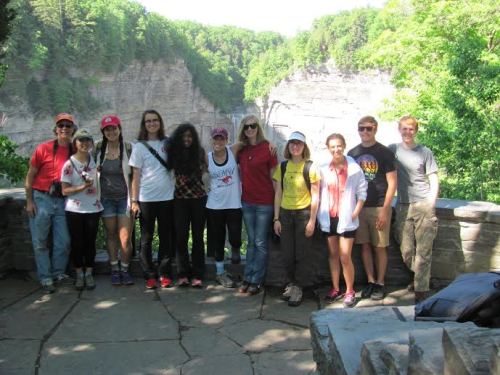
Photo above: summer interns take a break with a trip to Taughannock Falls.
Gwen Aviles ‘17 is a student writer for the College of Agriculture and Life Sciences.