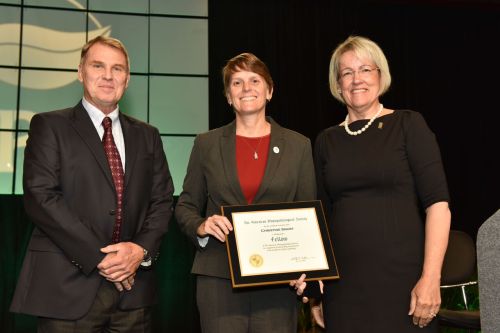
A pair of CALS plant disease experts earned honors from the American Phytopathological Society (APS) for their leadership and contributions to the field of plant pathology.
Adam Bogdanove and Christine Smart, both of the Plant Pathology and Plant-Microbe Biology Section in the School of Integrative Plant Science, were recognized at the APS Annual Meeting July 30-Aug. 3 in Tampa, FL.
Bogdanove, Ph. D. ’97, earned the Noel T. Keen Award for Research Excellence in Molecular Plant Pathology. He was selected for this prestigious award in part for the fundamental advances he has made in the understanding of bacterial pathogenesis of plants. Most notably, he was credited for developing genome editing methods inspired by molecular plant pathology, and for furthering understanding of the Xanthomonas-rice interaction. That finding has the potential to impact the control of two important diseases of rice.
Smart was named an APS Fellow in recognition of her distinguished contributions to plant pathology, including her work as a communicator and teacher. The APS lauded Smart for furthering the understanding of the biology of vegetable pathogens to enable improved disease management, and for her leadership roles. She serves as senior editor of APS Press, as a former associate editor for the journals Plant Disease and Phytopathology, and in various leadership positions across her field.