

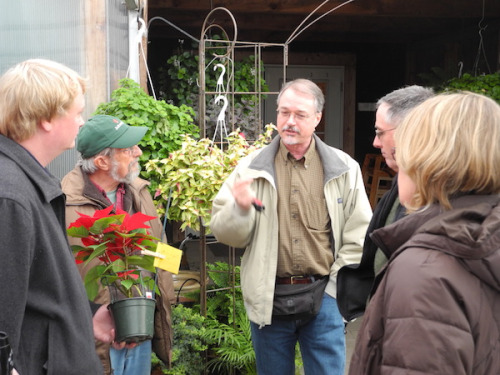
For 25 years, Cornell University professor of entomology John Sanderson has brought the latest and safest in integrated pest management to greenhouse growers all over New York. Now, for his boundless enthusiasm and contagious love of learning, Sanderson has received an Excellence in IPM Award from the New York State Integrated Pest Management Program (NYSIPM).
Sanderson is always a draw at grower IPM outreach events, says NYSIPM greenhouse specialist Brian Eshenaur: “his name on an agenda is an advertisement in itself. He’s an old pro in engaging his audience,” whether at field day walkabouts, workshops, or hands-on IPM road shows.
Most pests are tiny and adept at hiding. Some even carry plant diseases. Dealing with these constellations of pests isn’t easy. Sprays can fail—and pests’ evolving resistance to pesticides is a perennial problem for growers. Besides, who wants pesticides on their plants if they don’t have to? But evolving resistance to something that evolved to eat you borders on impossible. Thus Sanderson’s choice of research subjects: biocontrols. Biocontrols are organisms whose sole purpose in life is eating others—in this case eating pests that attack greenhouse crops.
“I have rarely seen so many light bulbs go off in growers’ heads as when John had them mix thrips and the thrips predator ‘Orius’ in a vial to see the biological control carnage,” says Elizabeth Lamb, an NYSIPM ornamental plant specialist. Once he’s showed his latest research results and how they relate to earlier discoveries, the rest is up to growers.
Sanderson’s patient, “every question is a good question” approach boosts grower confidence in trying new practices, especially if they see them in real-life settings—like a neighboring greenhouse, where “real-life” comes to life.
For example, in 2006, Lucas Greenhouses wanted to get off the pesticide diet. They turned to Sanderson for help. With his thoughtful guidance, says Debbie Palumbo-Sanders, who led the charge at Lucas, “we quickly reduced pesticide use by more than 95 percent.” And then? Lucas hosted other greenhouse growers who wanted to learn more the IPM approach. “It’s been John's deep commitment to educating growers that has helped move IPM forward in our industry,” Palumbo-Sanders says.
Sanderson received his award on August 9, 2016 at the Cornell University Floriculture Field Day.


