

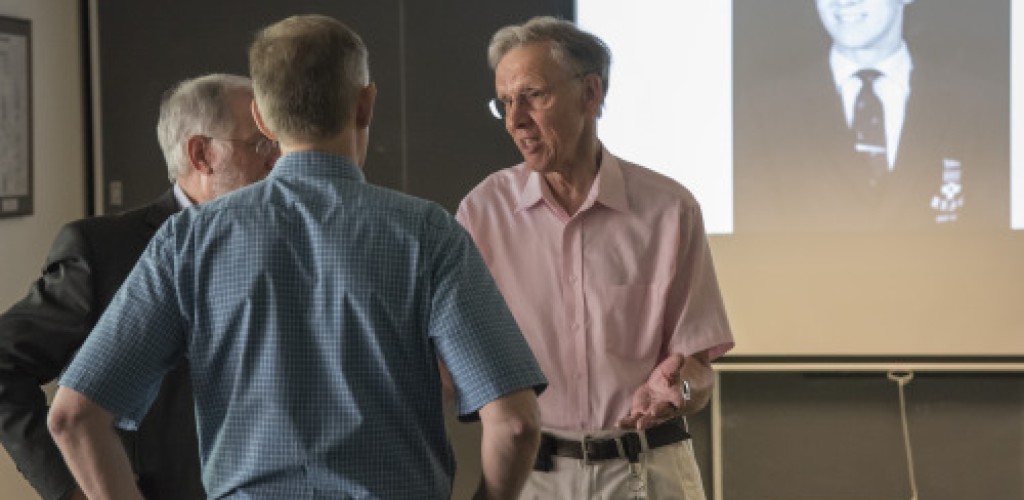
Peter Davies, a plant hormone expert who taught generations of Cornell students plant physiology during his career, retired in January after 46 years with the College of Agriculture and Life Sciences. A symposium was held June 17 at Emerson Hall in honor of Davies, now professor emeritus of plant biology.
Speakers at the symposium included Jim Reid, professor at the University of Tasmania, Australia; Sarah Evanega, director of the Cornell Alliance for Science and senior associate director at International Programs-CALS; and Ron Herring, professor in the Government Department.
Reid, a plant geneticist who has identified genes that regulate plant hormone synthesis and perception, called Davies a “champion of hormone physiology.”
Symposium moderator Fred Behringer, Ph.D. ’91 said Davies was influential in his field and always managed to inject good humor into the lab and classroom: “Peter brought a lot of energy and positive thoughts to all his work. He made it fun to work.”
Davies taught a popular course exploring issues in social biology at Cornell and has been a leading proponent of biotech crops. In 2011-12 he served as a Jefferson Fellow with the U.S. State Department as senior science adviser on biotech crops to the office of Agriculture, Biotechnology and Textile Trade Affairs in the Bureau of Economics and Business.
An expert in plant growth and development, Davies’ textbook on plant hormones is considered by many to be the standard authority in the field. He has published over 100 papers and written several books. In 2008, he was named the most influential faculty member at Cornell.


