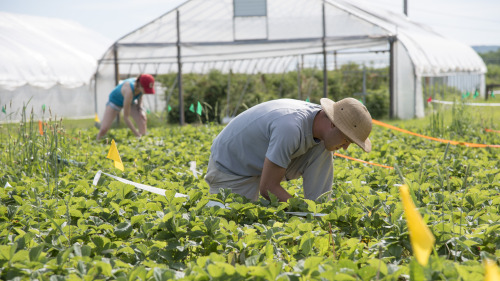
Marvin Pritts wants to know just what happens when the straw is taken out of strawberry growing.
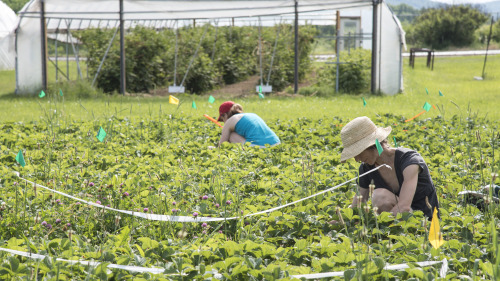
Pritts, professor in the Horticulture Section of the School of Integrative Plant Science, and his team of summer interns are exploring how inputs into the soil affect the quality of the strawberries produced.
Adding straw to the field seems like it should be beneficial to growth: after all, straw provides the soil with the organic matter plants need to thrive. The practice has long been utilized in strawberry growing operations: “Growers use the straw as protection for the berries and put the straw between the rows of plants so they can be easily harvested,” Pritts explained. But he wanted to know just how this practice impacts strawberry growth.
Last season Pritts and graduate student Maria Gannett, M.S. ’16 incorporated varying levels of straw, grass clippings, and wood chips — all differing in carbon/nitrogen ratios — into different plots of soil to test how plants reacted as the amendments decomposed.
The only plots that showed negative growth were the ones with straw in their soil.
A soil test developed at Cornell in 2006 allows researchers not only to ascertain important nutrients the like potassium and nitrogen content of the soil, but the biological and physical properties of it as well. The test had been used mainly for vegetables and other field crops in the past, but never berries. When Pritts deployed the test on grower farms he found low biological soil health where strawberries were grown.
Gannett attempted to determine if the microbiological agents from the straw amendment were the cause of the negative growth, but she could not find any pattern in the soil.
“We know now that straw has the potential to suppress growth, but the reason why it does so remains a mystery,” Pritts said.
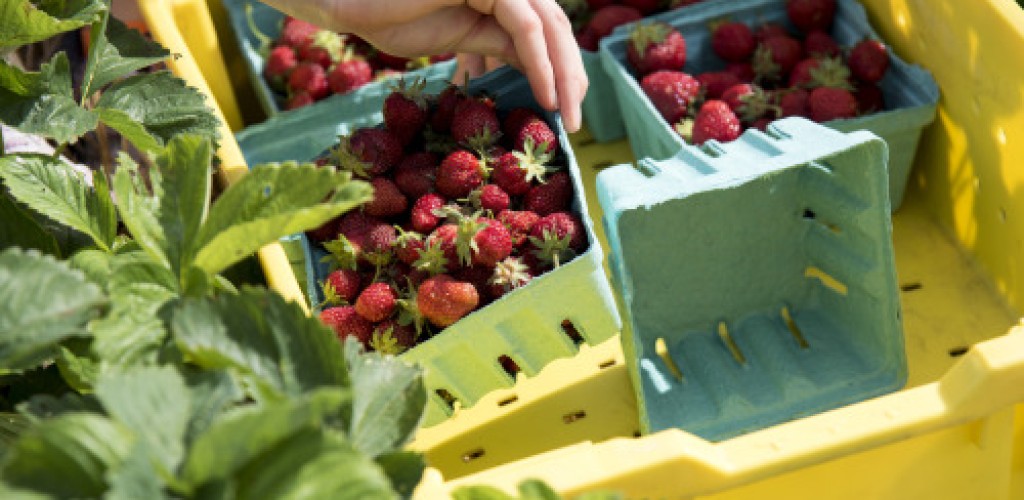
This summer, Pritts and his students are attempting to further uncover the mystery of straw and strawberry growing. By weighing the strawberries from each plot, interns are able to determine the exact strawberry yields of the season to determine if there are residual effects from the amendments. The interns are also assisting in the maintenance of apple and grape plants that will be used to make wine and cider for various classes in the fall.
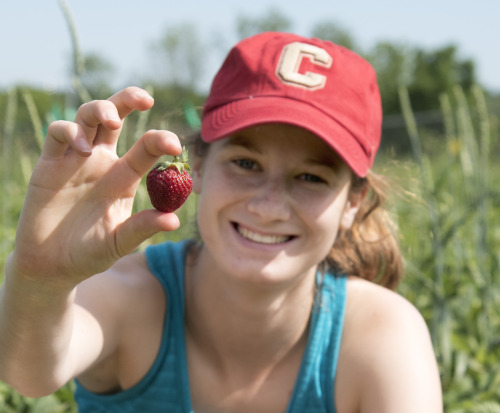
For the interns, being out in the field provides the chance to do meaningful science that could pay big dividends for growers across New York. Plus, said Annalise Carroll ‘17, it’s fun: “I like being outside; I like working with other interns. We’re all in this together,” she said of fellow students Patrick Commane ’17, Grace Montgomery ’18 and Simmone Landau ’19.
“I like hearing about all the different projects at Cornell. It’s pretty overwhelming when you think about all the projects people are doing,” Carroll added. “People here are doing novel research other people will reference later on.”
Gwen Aviles ’17 is a student writer for the College of Agriculture and Life Sciences.