

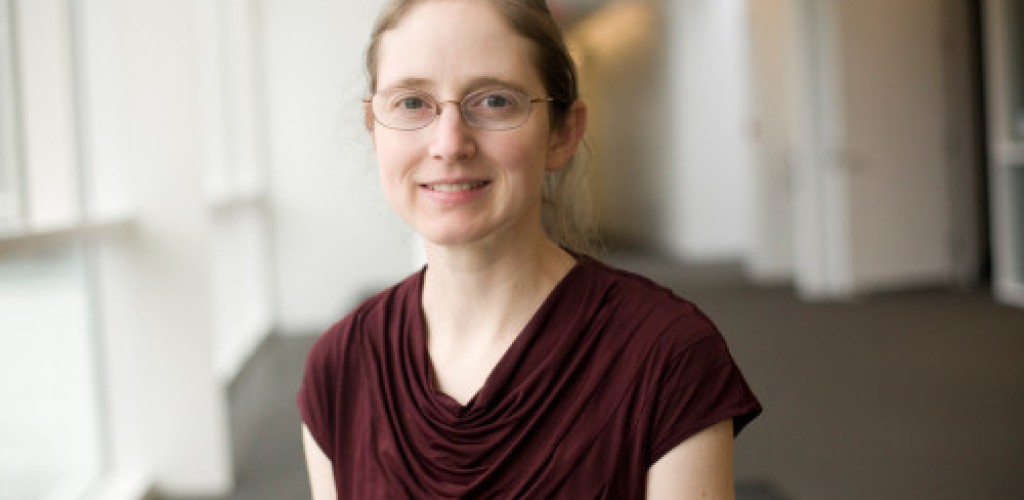
Increasing crop yields will become a larger priority as the population grows and the amount of farmland decreases. Adrienne H.K. Roeder, Weill Institute for Cell and Molecular Biology/Integrative Plant Science is studying a natural mechanism that, with enhancements, may help increase that yield.
The National Science Foundation (NSF) recently funded the the project “Initiation of Cell Size Patterning in Arabidopsis” under the direction of Roeder.
The grant from the Faculty Early Career Development (CAREER) Program offers the NSF’s most prestigious awards in support of the early career-development activities of those teacher-scholars who most effectively integrate research and education, according to the NSF. The award is expected to total $988,503 over five years.
The cells in the edible parts of corn, beans, rice, wheat, and peas undergo a specialized process called endoreduplication, where cells replicate their DNA many times. But when geneticists try to increase endoreduplication, they find that the response of seemingly identical cells is somewhat random: some cells respond strongly, some moderately, and some not at all — in the same proportions from plant to plant. This observation raises one of the biggest questions in developmental biology: how do identical cells make different decisions?
With a CAREER award from the National S, Roeder will investigate how random molecular differences affect cells’ endoreduplication — and how randomness, surprisingly, may be necessary for reproducible development.
Roeder and her team will use sepals of the flower Arabidopsis thaliana, which have accessible epidermal cells for live imaging of endoreduplication, and will investigate the role of a transcription factor, Arabidopsis thaliana MERISTEM LAYER1 (ATML1), in driving endoreduplication. Specific goals include uncovering the molecular mechanism through which ATML1 induces endoreduplication as well as how ATML1 feedback loops amplify ATML1 expression. Students at Cornell, as well as local middle school students, will receive training in image analysis and computational skills.
A portion of this article originally appeared in Cornell Research.


