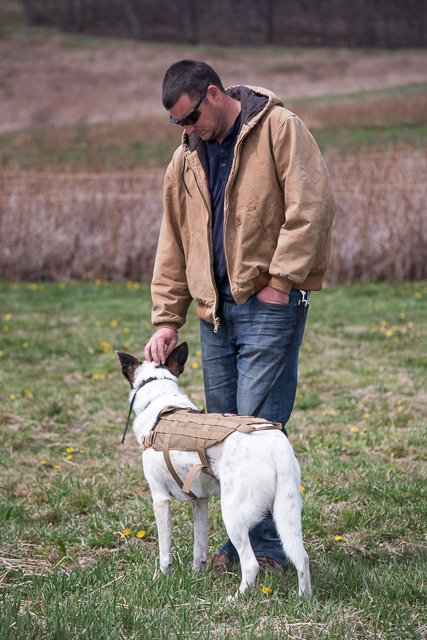
As a member of the Seabees, the U.S. Navy’s elite construction battalion, James Turrell spent seven years putting his blood, sweat and building expertise to work all over the world, including stops in Guantanamo Bay, Cuba and Fukishima Japan following its 2011 earthquake and corresponding nuclear disaster. The work was fulfilling and rewarding—and hard for Turrell to walk away from.
But in 2012, when a medical retirement ended his military career, Turrell was tasked with building a new life in the private sector. Realizing he needed an occupation that allowed him to be his own boss, work with his hands and do something that created a tangible and positive outcome, Turrell chose to become a farmer.
Turrell’s Transition from soldier to farmer is one that the USDA and locally-based organizations such as Cornell Cooperative Extension (CCE) and the Cornell Small Farms Program (CFSP) would like to see replicated on a larger scale. As older farmers begin to retire and the U.S. military trends toward downsizing, the theory is that ex-soldiers, many of whom come from rural backgrounds and are searching for new career opportunities, would be ideal candidates to step into agriculture roles.
To help New York’s military veterans navigate this process, CCE and CFSP are partnering on a series of educational programming opportunities designed to provide knowledge and resources to facilitate entry into agribusiness.
One recent event was a workshop titled Veterans Growing Berries held on a late-April Saturday in Broome County.
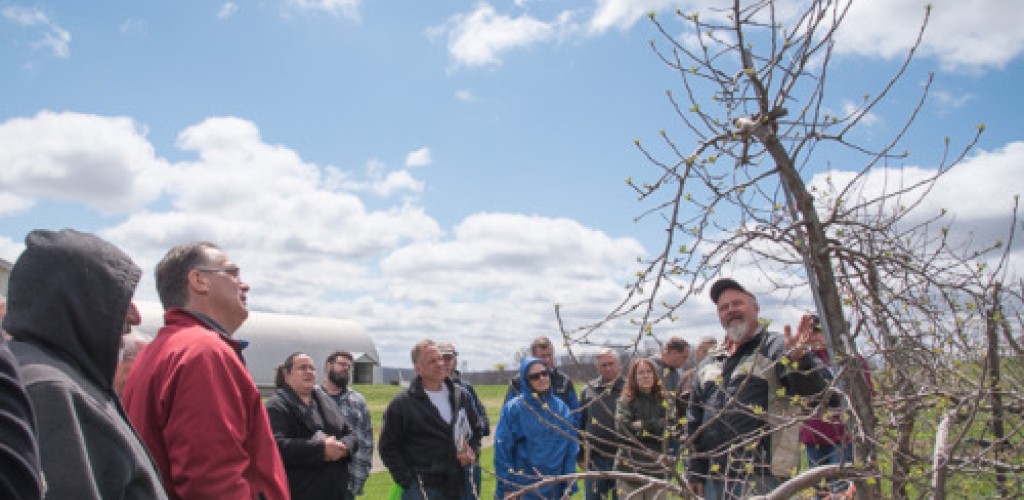
Looking to add berries to his crop offerings, Turrell and his service dog, Rookie, who is trained to assist with PTSD symptoms, traveled to Apple Hills farm in Chenango, NY. There, they joined 13 other military veterans as well as 16 additional community members to learn the ins and outs of selling and marketing berries and operating a U-pick farm.
Highlighted by a spirited morning educational session on berry production and industry analysis led by Cornell Plant Science Professor Marvin Pritts, who previously owned a popular U-Pick strawberry farm, the event also featured a business planning session, and an afternoon tour of the Apple Hills’ berry patches and apple orchard with owner Dave Johnson ’81.
“We were very heartened to see such a great turnout of veterans from around the state at this event,” says Matthew Weiss, projector coordinator for the CSFP Beginning Farmer project. “Veterans Growing Berries kicks off a robust season of beginning farmer training programs focused on supporting veterans in agriculture.”
Viewed as a win-win proposition that would match qualified personnel with a vocation facing labor needs, introducing military veterans to agribusiness has become an educational priority across the state and the country.
“Many transitioning service members bring a unique set of skills and a can-do attitude to farming that help them excel in the field,” says Weiss. “At the same time, we talk to veterans who say that farming has allowed them to find a fulfilling career after they have served. Our job is to provide educational opportunities, like this one, which provide the training and tools they need to start farming or locate meaningful careers in the agriculture sector.”
Though he misses his days with the Seabees on occasion, Turrell’s entry into farming has given him the opportunity to retain his builder’s touch. After leaving the Navy, Turrell rebooted a dormant 400-plus acre farm in Oneonta, NY, that has been in his family for generations. Though the farm had plenty of history–a ram raised by Turrell’s great grandfather won a medal at the 1911 World’s Fair—it was void of crops and had but a handful of sheep when Turrell took over.
Now, three-and-a-half years later, the farm is home to a herd of beef cows and Turrell grows pumpkins, corn and a variety of vegetables that he sells at his small roadside farm stand. He also exhibits at local farmers markets and sells produce to a handful of Oneonta-area restaurants. It’s been a slow arduous journey, but Turrell says it has been well worth the effort.
“Farming really is an ideal path in terms of the freedom you have and the personal fulfillment it provides, but it’s not easy,” he says. “There are so many challenges, and so I’m always looking for ways to improve my operation. Workshops like this, where I can talk to people like Dr. Pritts about the complexities of growing fruit and learn about better business practices are a good way to do that.”
Military veterans interested in participating in future events can view a calendar on the Cornell Small Farms Program veteran project website.