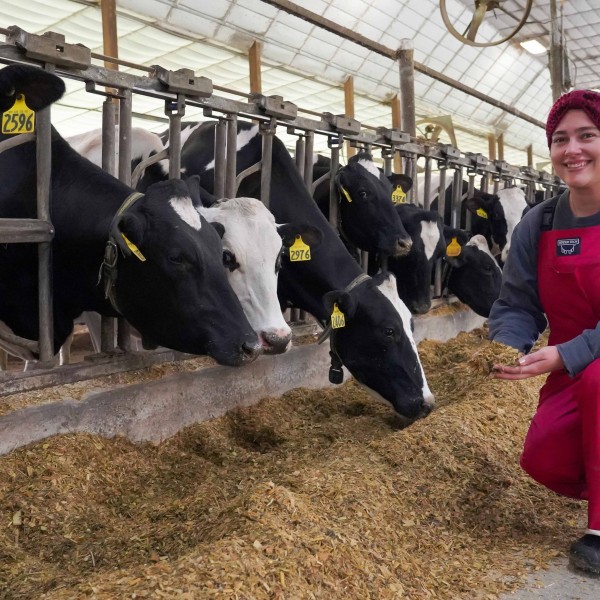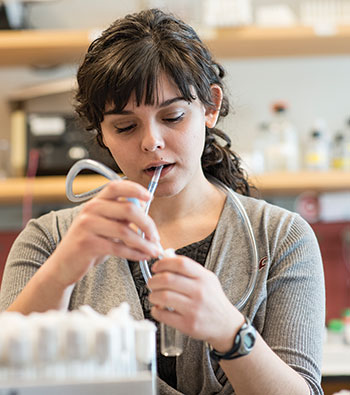
Senior Allie Cohen is looking forward to hanging up her lab coat and heading to law school, but not until she untangles a few more mysteries of fruit fly mating. The biology and society senior—and six-year veteran of fruit fly research—will choose from among the many law school acceptances she’s received, a first step toward dual degrees in law and public health.
“I guess I’m impatient to see impact,” Cohen admitted. “I think it suits my temperament to work in policy, where a recommendation to government or hospitals, based on research, can affect people in a year.”
As a Hunter R. Rawlings III Cornell Presidential Research Scholar, Cohen began working with Mariana Wolfner A.B. ‘74, professor of molecular biology and genetics, during her second semester at Cornell. Hundreds of hours of careful observation made her an expert in the intricacies of fruit fly mating, specifically the mating plug—a self-assembling barrier to keep one male’s sperm in and others’ sperm out. She knows the suave moves of the males’ courtship dance, which she compares to John Cusack’s iconic moment in Say Anything, only the flies hold up vibrating wings instead of a boom box.
Her work evolved from studying the individual proteins that comprise the mating plugs into an independent study of the unique characteristics of the ejaculatory bulb in male flies. Looking at thousands of them, she realized that the tiny organ’s shape seems to change during the course of mating.
“The interesting part was that inflation of the bulb starts during courtship, before there’s even any contact between the two flies,” Cohen said. “Tracking the pattern of inflation and deflation, we think that it seems to be beating, almost like a heart, and that it’s wrapped in muscle.”
Cohen credits Wolfner for letting her develop independence as well as supporting her as she weighed her career options, from lab science to bioethics and finally into policy. The Rawlings III Cornell Presidential Research Scholar program also played a key role.
“I wouldn’t be in this position now if it wasn’t for the Rawlings program,” Cohen admitted. “The funding allowed me to spend a summer at Oxford studying bioethics, which turned out to be a path I decided to not go down. Rawlings allowed me to explore other options, and without that I would not be in the same place.”