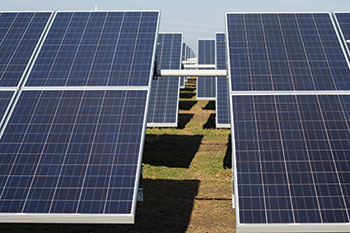
Bring on the sunshine: Cornell’s new Sutton Road Solar Farm, a two-megawatt energy facility that will offset nearly 40 percent of the annual electricity demand at the New York State Agricultural Experiment Station in Geneva, N.Y., will be fully operational later this spring.
“Within our fruit and vegetable programs we’re studying the best way to harvest the sun, so it is only fitting that the energy powering our labs and greenhouses will do the same,” said Susan Brown, the Goichman Family Director of the station.
The Sutton Road Solar Farm, a 17-acre facility featuring 9,120 photovoltaic panels located in Seneca, N.Y., is Cornell’s second large-scale solar project. In September 2014, the university opened the Cornell Snyder Road Solar Farm with 6,778 photovoltaic panels on an 11-acre plot that adjoins the Tompkins County Regional Airport in Lansing, N.Y. Adding the new array to the Lansing facility’s output, the university will produce about six megawatts of electricity annually.
“Moving from the natural gas-dominated heating and electric system to renewable energy is necessary to meet Cornell and New York state’s goal of decarbonizing energy,” said Bert Bland, associate vice president for energy and sustainability in the university’s Infrastructure, Properties and Planning division.
A NY-Sun award, administered by the New York State Energy Research and Development Authority, contributed about one-third of the project’s capital cost, while private developer Distributed Sun will own and operate the new array. Jeff Weiss, a 1979 Cornell graduate, is co-chairman and managing director at Distributed Sun. Cornell will purchase the solar farm’s electricity through an agreement with the company.