A family with more than three decades of experience in food ingredient technology has enabled the Department of Food Science to pursue big opportunities in small-scale packaging, with the recent hiring of an expert in micro- and nanotechnology and food formulation.
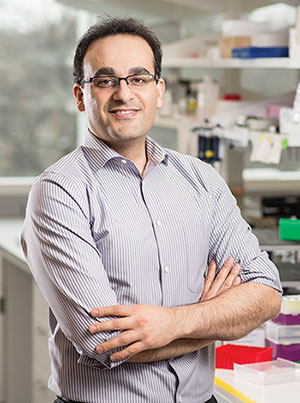
Yongkeun Joh, M.S. ’78, the founder and president of Advanced Food Systems in Somerset, N.J., and his wife and business partner, Sunny Joh, M.S. ’77, endowed the Yongkeun Joh Professorship of Food Chemistry and Ingredient Technology. The position and its inaugural appointee, Assistant Professor Alireza Abbaspourrad, will focus on micro- and nanoencapsulation, techniques that package ingredients into tiny capsules a fraction of the width of a human hair. The process can be used to improve a food’s nutritional quality, stabilize natural ingredients and provide controlled release of pharmaceuticals.
Abbaspourrad, an organic chemist by training, got hooked on microfluidics and microencapsulation while a postdoctoral associate at Harvard University. In the five years since, he has used the technique in diverse applications, including oil recovery, fuel additives, fragrance in laundry detergent, controlled release of enzymes, natural colors for candy, and nutrient bioavailability.
“The encapsulation process basically retains and protects what’s inside the capsule and provides targeted delivery,” Abbaspourrad said. “If you want to deliver an active material to a specific location and release it under predefined conditions, microencapsulation can be the key.”
At Cornell, Abbaspourrad will test microencapsulation systems to enhance the digestion and bioavailability of nutrients and ingredient stability within prepared foods. He will also bring this expertise into the classroom by teaching two courses: Chemistry and Functional Properties of Food Ingredients and Food Product Development. The position is just one of many ties between the Johs and Cornell.
“Cornell is more than just an alma mater to us,” Yongkeun Joh said. “We always thought we should give back.”
The Johs met at Cornell as graduate students—Yongkeun in food science and Sunny in pomology—and they married while completing their studies. Since 1982, their company has developed and manufactured customized ingredient systems for food products that can be found in many chain restaurants, fast-food products and pre-packaged foods throughout the world.
The Johs have created scholarships and programs over the years, including the Joh Family Graduate Support Fund in the Department of Food Science, specifically designated to aid Asian students. Additionally, they have provided support for academic and cultural programming for Korean students, the Herbert F. Johnson Museum of Art, and Shoals Marine Laboratory. Yongkeun is a former member of the CALS Dean’s Advisory Council, and the Johs received CALS Outstanding Alumni Awards in 2011.