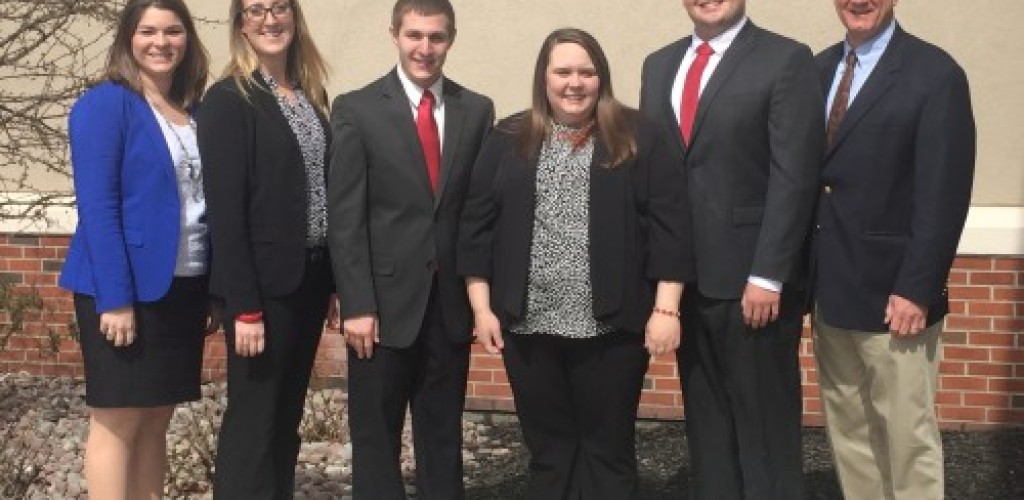
A team of Cornell animal science students can add a new line to their resumes: continental champions.
Seniors Josh Landis, Kelsey Neckers, Greg Van Ravenswaay and Colleen Smith earned first-place honors in the North American Intercollegiate Dairy Challenge, held April 7-9 in Syracuse. The event brought together teams from 39 colleges to test their ability to apply theory and learning on a real-world dairy farm.
Animal science professor Mike Van Amburgh and extension support specialist Betsey Howland coached this year’s team, whose members were selected by seniors in the Cornell Dairy Fellows Program. Cornell has a history of success at the Dairy Challenge, having captured first-place honors five times since 2010.
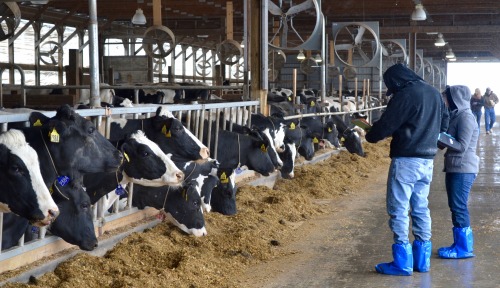
For this year’s competition, teams visited one of four Central New York farms and evaluated the entire dairy, including financial and operations analysis. For their particular farm, Cornell competed against seven other teams from colleges in the U.S. and Canada.
Each team developed recommendations for nutrition, reproduction, milking procedures, animal health, cow comfort and financial management, which they presented to industry experts. The judges evaluated each team’s presentation based on content and style.
The Dairy Challenge’s unique business component gives students the opportunity to evaluate and make pro-active recommendations to a dairy owner based on an actual business case-study, said Van Amburgh.
“This team represents our entire Dairy Fellows Program, and their success is really a testament to the way the program prepares students to engage in the technologically advanced and complex modern agricultural industry,” Van Amburgh said.
Smith, president of the Cornell University Dairy Science Club (CUDS), said the team practiced throughout the semester in preparation for the event.
“Winning Dairy Challenge has been one of the most rewarding experiences of my life,” Smith said. “I can honestly say that this has been one of the greatest learning experiences that I’ve had at Cornell.”
Howland added, “Our students become animal science leaders once they leave Cornell, and this competition gives them the chance to apply their skills and knowledge against peers at other colleges. The future of agriculture is bright, especially with talented and dedicated students like this team entering the agricultural workforce after graduation in May.”
Other winning teams included California Polytechnic State University, University of Wisconsin-River Falls, and University of Wisconsin-Madison.