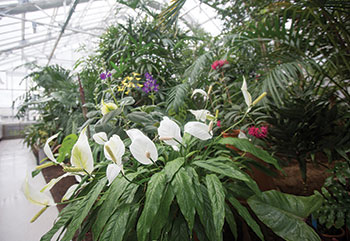
The rebuilt Liberty Hyde Bailey Conservatory Greenhouse opened Feb. 9, continuing the legacy of botanical discovery of its namesake, the first dean of the College of Agriculture and Life Sciences. The 4,000-square-foot facility on Tower Road features modern equipment designed for increased energy savings and improved plant growth. But the spirit of the conservatory remains fixed on the ideals of education and outreach, according to Professor Karl Niklas. “The collection is a living archive describing the wondrous diversity of plant life,” said Niklas, the Liberty Hyde Bailey Professor of Botany. “Generations of Cornell students have relied on the conservatory to bolster their knowledge. The conservatory also provides students, staff and faculty with a green oasis in which to seek solace during the winter months. It promises to extend these important intellectual and emotional functions for many more years to come.” Housing more than 500 species from nearly 80 different families, the greenhouse maintains an indoor climate ideal for plants native to tropical, subtropical and other regions, including two of the university’s famed corpse flowers, as well as orchids, cycads, palms, cacti, coffee and cocoa plants. The Liberty Hyde Bailey Conservatory is open to the public. Hours and other information can be found at conservatory.cals.cornell.edu.