

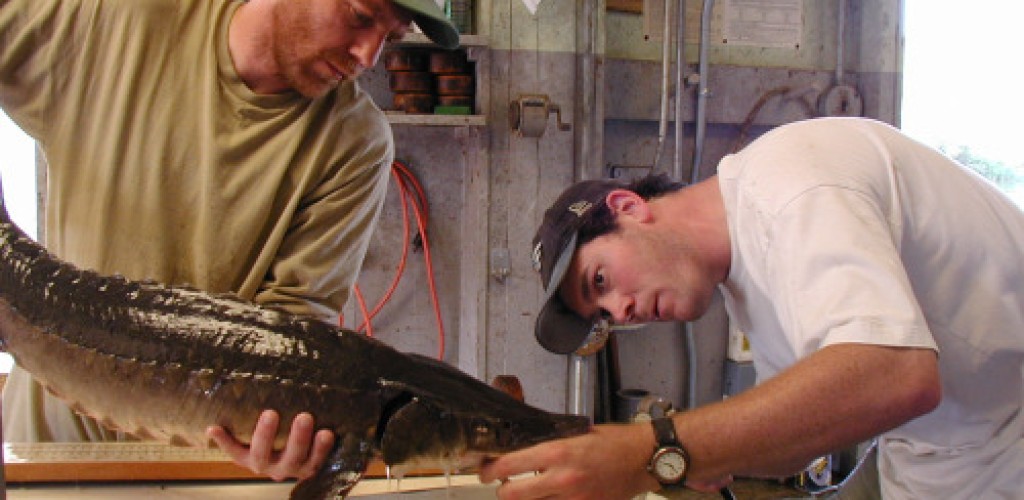
In six decades of research on Oneida Lake, the Cornell University Biological Field Station at Shackleton Point has studied all of its facets, characteristics and natural dimensions.
Now a new book, “Oneida Lake: Long-term Dynamics of a Managed Ecosystem and Its Fishery,” reviews the sweeping environmental research conducted on New York state’s largest interior lake.
“What is rare about this book? Seldom are such long-term studies of a single ecosystem maintained over time,” said University of Wisconsin professor John Magnuson in the book’s preface. “Seldom has such information been documented in detail, synthesized, analyzed and published in a single volume; and seldom have researchers and institutions come together to make the data available to the global community of researchers.”
The book, published by the American Fisheries Society, was edited by Lars G. Rudstam, professor of natural resources; Edward L. Mills, emeritus professor of natural resources and director of the station; Randy Jackson, senior research associate, studying conservation of fishery resources and aquatic ecosystems; and Donald J. Stewart, professor at the State University of New York’s College of Environmental Science and Forestry.
Oneida Lake – heavily used for boating, jet-skiing and sailing, and by thousands of sunbathers on Verona and Sylvan beaches – has a large number of anglers, ranking second only to Lake Ontario.
The book pores over the lake’s history and scientific data, explaining predator-prey dynamics, examining watershed and lake-level manipulations, nutrient and biogeochemical cycling, the zebra mussel invasion, water quality studies, understanding the walleye and yellow perch populations, and forecasting the lake’s future.
Among other topics, scientists recount how cormorant (aquatic birds) predation has taken its toll on the lake, by consuming walleye, yellow perch and other fish. Cormorants were in such command that by the mid-1990s the walleye and perch were one-third abundant as their average population level over the previous 35 years. The book details the effective management program that reduced the cormorant populace on the lake by about 80 percent from the peak in the late ‘90s.
The book predicts a changing future for Oneida Lake. Due to climate change, scientists see warmer summer water temperatures, shorter durations of surface ice in winter, increased water stratification, more black bass, increased cyanobacteria blooms and anoxia (the lack of oxygen in the water).
By Blaine Friedlander. This article originally appeared in the Cornell Chronicle.


