

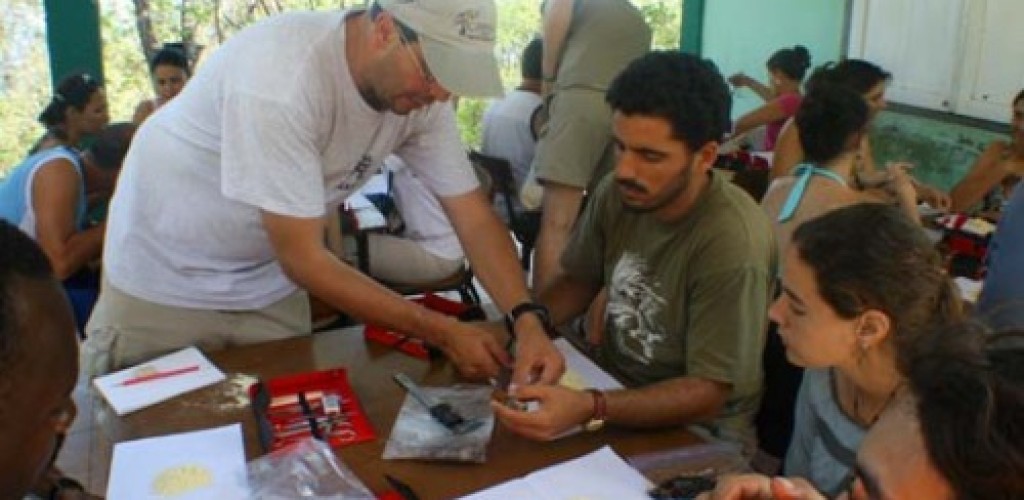
Cornell ornithologist Eduardo E. Iñigo-Elias has been recognized by a branch of the Cuban Academy of Science for his research on bird biology and conservation in the island nation.
The Cuban Zoological Society honored Iñigo-Elias with the Juan Cristóbal Gundlach award, given to foreign scientists whose significant achievements have promoted zoological study in Cuba. The society acknowledged the Cornell researcher for his ornithological collaboration. Together with the Cornell Lab of Ornithology and his Cornell team, he has spent 14 years training and building capacity in Cuba for bird biology and conservation.
Iñigo-Elias is a senior research associate at the Conservation Science Program in the Lab of Ornithology, part of the College of Agriculture and Life Sciences. The Lab of Ornithology, in collaboration with the John D. and Catherine T. MacArthur Foundation, the Christopher Reynolds Foundation, and multiple academic and conservation institutions, work together to forge conservation strategies and address critical threats to birds and biodiversity. The goal of the program is to secure bird populations and habitats throughout the Western Hemisphere through research, teaching, training, dissemination of scientific knowledge, and partnerships that influence policy.
Iñigo-Elias has focused much of his research on conservation issues surrounding tropical forest, parrot ecology, seabirds and insular ecology, restoration ecology and eradication of invasive species in islands as well the biological and socio-economics of the wild caught bird trade.
Gundlach, whose name graces the award, was a naturalist and taxonomist who completed the first major investigation of Cuban birds during the 19th century.
“Birds are a natural resource shared by the USA and Cuba. They play an important economic role as well ecological service, and are beautiful and critical components to the world’s ecosystem,” Iñigo-Elias said. “I’m honored to have been acknowledged with this prestigious award, which is a collective recognition to the efforts from many of my colleagues at Cornell and in Cuba.”
He will receive the award March 20 in Havana.


