

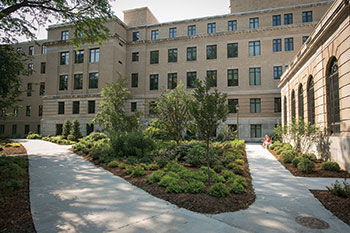
Steeped in economic and social science history, Cornell’s Warren Hall—refurbished, renovated and reinvigorated for teaching and research long into the new century—has added a sustainable trophy to its storied resume: LEED Platinum certification.
Featuring salvaged stone flooring, energy efficiency, corridors of daylight, natural ventilation and even gardens in the sky, the updated Warren Hall brings a modern sense to granite walls. On the Cornell campus, two new buildings have achieved platinum status, but this is the first campus renovation to reach the Platinum LEED (Leadership in Energy and Environmental Design) level, the highest certification by the U.S. Green Building Council.
“The project team's goal from the start was to deliver a modern building with a zero increase in the energy use. They accomplished this task by making some brave decisions,” said Matt Kozlowski, associate manager of Cornell’s Green Building Program. “To make a meaningful impact on energy use as a whole, we need to tackle the renovation and renewal of our existing building stock.”
FXFOWLE Architects, known for its design excellence, social responsibility and sustainability, updated Warren Hall.
While a mechanical designer can add a traditional HVAC system, the Warren Hall project team installed user-controlled trickle ventilation into exterior windows, decoupled heating and cooling from the ventilation system, insulated and repaired the building’s exterior, and found ways to bring sunlight deep into the interior, according to project manager Brian Fish.
Warren Hall’s auditorium roof is covered with drought tolerant sedum plants for insulation, storm water treatment and longevity. Commonly called stonecrops, they feature succulent, water-storing leaves.
Warren Hall—originally called the Agricultural Economics Building—was built in 1932, courtesy of the New York State Legislature and New York Gov. Franklin D. Roosevelt. The building’s original tenants—the Departments of Agricultural Economics, Farm Management and Rural Social Organization—remain today in their modern incarnations: The Charles H. Dyson School of Applied Economics and Management and the Department of Development Sociology.
Warren Hall was rededicated on April 24, marking the culmination of a four-year, $51 million project that College of Agriculture and Life Sciences Dean Kathryn J. Boor hailed as a triumph of good partnerships, careful planning and good will.
“Warren Hall embodies the spirit of interdisciplinary learning, discovery and engagement that defines CALS,” Boor said. “And now it also embodies the college’s spirit of sustainability.”


