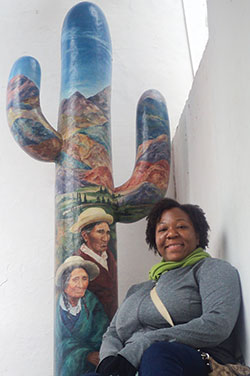
Jonathan Gorman ’16 and Zachia Gray ’16 are the first students to study abroad in Argentina as part of a new pre-veterinary CALS Exchange Program. The students traveled to Esperanza, Argentina, in January to study at the Facultad de Ciencias Agrarias y Veterinarias at Universidad Nacional del Litoral. They took an intensive Spanish course, followed by a semester of pre-veterinary science courses in Spanish at the university. Gray, an animal sciences major, said she was impressed by the kindness and patience of the students and professors with whom she interacted.
“Everybody was helpful, willing to help explain things to us, to speak more slowly, whatever we needed,” she said.
“I think I have a better sense of independence and self-confidence now,” said Gorman, a biological sciences major. “This is the first time I’ve had to rely on a foreign language, and it feels empowering to have that experience.”
In Argentina, Gorman had the chance to go out in the field with animal science researchers, which he credits with giving him a better sense of the diversity of work veterinarians do. On one trip, the group consulted with a dairy farm coping with low milk output; at another, they studied a collar that projects when a cow is capable of conceiving, to determine the best time for artificial insemination.
Gray said the experience affirmed her desire to go to vet school after she graduates. She’s hoping to specialize in wildlife health and rehabilitation.
“Having that experience of being in classes with other vet students, talking through the medical and veterinary aspects of these problems, this is definitely what I want to do,” she said.