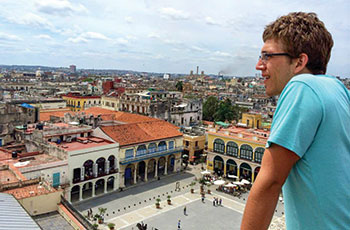
In December 2014, U.S. President Barack Obama and Cuban President Raul Castro announced that they would normalize relations between our countries. By January 2015, Cornell’s first two undergraduates were on their way to study abroad in Havana.
Ian Pengra ’16 (CALS) and Wesley Schnapp ’16 (Arts & Sciences) inaugurated the new Cornell in Cuba program, studying at the University of Havana and conducting research with renowned Cuban biology professor Emanuel Mora. The universities signed an exchange agreement in April 2014, initiating the process that enables Cornellians to study in Cuba and vice versa. The first Cuban student came to Cornell this summer.
For their research project, Pengra and Schnapp studied bat communication. They took pre-recorded bat distress calls and played them near a cave populated by hundreds of thousands of bats. Then, using an ultrasonic microphone, they listened in on the bats’ reactions.
“They are always echolocating, but we saw that the number of ‘pings’ per minute skyrocketed every time we played a distress call,” Pengra said. “They’re either directing their calls to see why the bat is in distress, or else they just feel more distressed themselves and so are calling out more frequently.”
Pengra said the experience helped him learn to develop better research questions and to appreciate supplies that most Cuban researchers have to do without, including adequate batteries and LED lights.
“It helped me realize that to be a good researcher—and Emanuel is a top-quality researcher—what you really need is to be able to ask good questions and know how to exploit what you have available to you. They have amazing biodiversity available,” Pengra said.
In spite of the 50-year embargo between Cuba and the United States, Pengra said he never felt any animosity from the Cubans with whom he interacted—quite the opposite, he was impressed by their generosity.
“For one field expedition, we stayed at a water buffalo ranch, up on one of their fields near the cave. Around breakfast time, we came out and saw that the people who owned the farm had brought out bowls of chicken soup, cheese, coconut paste. They just brought out literally everything they had in their fridge to share with us,” Pengra said. “The philosophy is basically, you share what you have. You’ll inevitably run out, but until then, you share what you have with the people that you love. That was a really profound thing to learn.”