

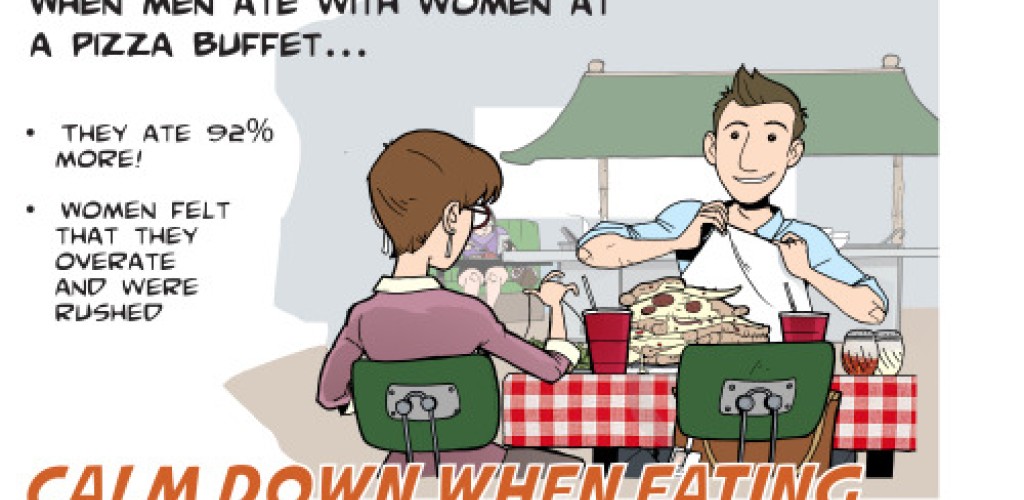
Men have a reputation of doing just about anything to show off in front of women, no matter how seemingly absurd. That effort to impress apparently extends to their eating habits: A new Cornell study shows men eat significantly more food when in the company of women, a finding, researchers suggest, that has to do with a hardwired male urge to demonstrate prowess to the opposite sex.
For the study, Cornell researchers from the Food and Brand Lab observed adults lunching at an all-you-can-eat Italian buffet. They found men who dined with at least one woman ate 93 percent more pizza compared with those who ate exclusively with other men. That tendency to overeat extended to healthier options as well: Men ate 86 percent more salad in the company of women.
An explanation of the findings can be traced to an evolved tendency to show off to the opposite sex, according to Kevin Kniffin, visiting assistant professor at the Charles H. Dyson School of Applied Economics and Management and lead author of the study. Brian Wansink, professor and director of the Food and Brand Lab, and Ozge Sigirci, a former visiting scholar at the lab, are also authors of the study published Nov. 10 in the journal Evolutionary Psychological Science.
“The findings suggest that men tend to overeat to show off,” Kniffin said. “Instead of a feat of strength, it’s a feat of eating.”
You can read more about the findings at the Cornell Chronicle: http://news.cornell.edu/stories/2015/11/men-eating-excess-might-mean-eating-impress


