

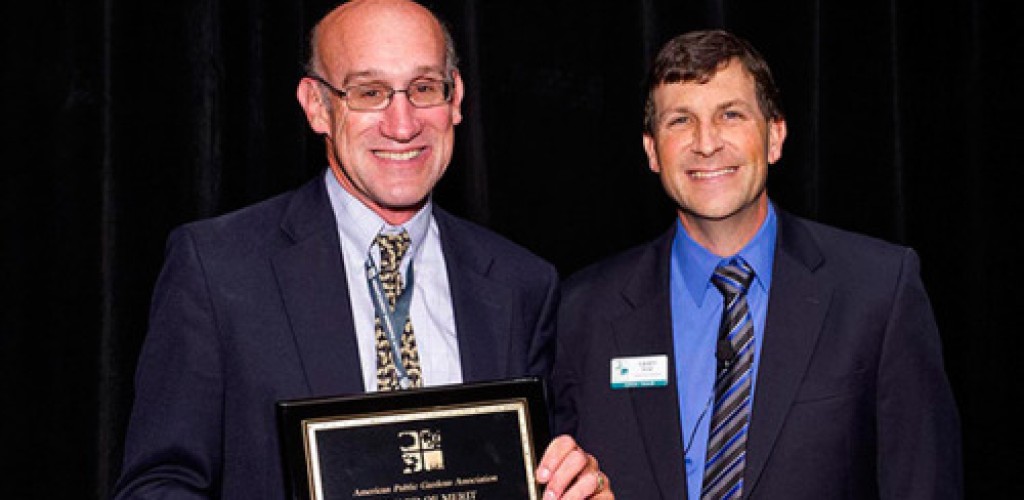
Donald Rakow, Associate Professor, Horticulture Section, School of Integrative Plant Science, and former director of Cornell Plantations, received the American Public Gardens Association’s 2015 Award of Merit at the APGA’s 39th Annual Conference June 25 in Minneapolis-St. Paul, Minn.
The Award of Merit recognizes an APGA member who has performed with distinction as part of an illustrious career in the field of public horticulture. Among Rakow’s accomplishments cited by APGA were the creation of Cornell’s Graduate Program in Public Garden Leadership, a doubling of Cornell Plantations staffing under his watch, and raising $14 million through a combination of endowments, annual fund support and capital projects, culminating with the dedication of the Brian C. Nevin Welcome center in 2010.
CALS Dean Kathryn Boor said, “Don’s leadership has been a key part of the transformation of Cornell Plantations in the last two decades. I am grateful for his expertise, enthusiasm and partnership.”
Also honored at the conference with an APGA Professional Citation Award was Michael Dosmann (Ph.D., Graduate Field of Horticulture, ’07), now curator of the Living Collections at the Arnold Arboretum of Harvard University. The award recognizes individual achievements, skills, innovation and potential in botany, horticulture, conservation, research, education, or administration.


