

By Celina Scott-Buechler ’18
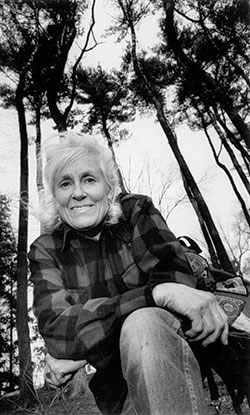
Women have played a key role in conservation science since the founding of the field, and in the past century few played a larger role than the late author and scholar Anne LaBastille ’55, Ph.D. ’69. Her Thoreau-inspired “Woodswoman” book series spurred women to study the natural sciences, and a new $300,000 self-sustaining scholarship funded by her estate will provide financial assistance to female doctoral students studying conservation or natural resources.
“She was truly a trail-breaker, a fiercely independent woman who could never sit still. Whenever she hit a wall, she broke right through it,” said Leslie Surprenant, the director of the Office of Invasive Species Coordination at the New York State Department of Environmental Conservation and a close friend of LaBastille.
In addition to publishing more than a dozen books and 150 popular articles, LaBastille became the first female Audubon Society tour guide, operated one of the first eco-tourism businesses in the United States, and created a natural wildlife reserve surrounding Lake Atitlan in Guatemala to protect the flightless giant grebe, for which she was awarded the World Wildlife Fund gold medal in 1974.
“I think her greatest legacy is to the women in natural resources and conservation,” said Gemara Gifford, a current graduate student in Natural Resources. “I see a lot of aspects of what I’m trying to do in the work she did, and know that I probably wouldn’t be here if she hadn’t paved the way for women.”


