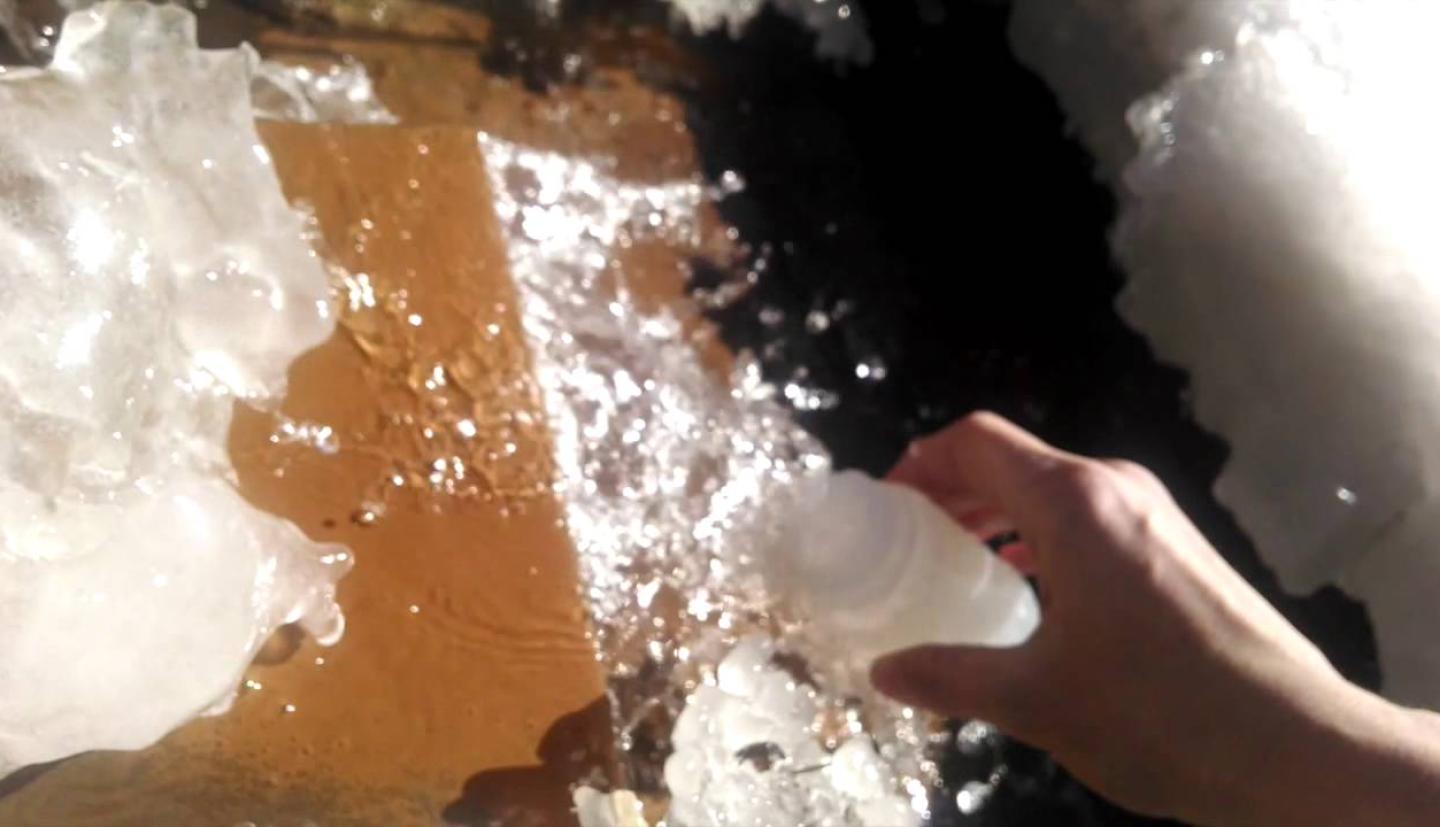
The students found salt residue lasts all year long in the soils contained in storm-water retention basins and that the high salinity levels appear to be changing the composition of soil microbes.
“Salinity levels in streams across the Northeastern United States have been steadily increasing for several decades, and the culprit is clearly road salt,” said Todd Walter, associate professor of biological and environmental engineering, fellow at Cornell’s Atkinson Center for a Sustainable Future, and adviser to the students. “There is less information about salt in storm-water systems, like the ones these students monitored,” he said.
After winter 2013-14, Cornell undergraduate students measured salt concentrations in water flowing out of storm drains and into Cascadilla Creek near the Synchrotron Drive bridge on campus and at Dryden Road, near Route 366, in Ithaca.
Water samples were checked continually from February to November 2014, and chloride concentrations peaked at 25 grams per liter. The report noted that the average chloride concentration for seawater is 30 grams per liter. Ultimately, summer storms flushed a lot of the salt, and concentrations fell to 0.63 grams per liter; natural levels of chloride in streams are close to 0.001 grams per liter.
Shane DeGaetano ’15, Sarah Nadeau ’16 and Erin Makarsky ’16 conducted the research under Walter, in collaboration with Cornell Facilities Services. DeGaetano presented a poster on the research at the American Geophysical Union meeting last December in San Francisco.