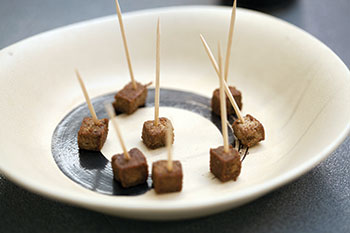
Think tofu but with a creepy-crawly, sustainable twist: A Cornell food science team has developed a new protein product—C-fu, made entirely of crushed mealworms—which may help feed the world’s booming population, a projected 9 billion people by midcentury.
“C-fu can do a lot of things because it’s not just a single product. It’s a raw material that can be the platform for a whole new array of insect-sourced foods. It’s analogous to fresh cheese or tofu, which can be modified or reprocessed into hundreds or even thousands of very different foods,” said Lee Cadesky, a graduate student in the field of food science, who leads the team.
Fried, boiled, baked, dipped, grilled, fermented, salted or dried, C-fu has been described as “nutty,” “bready” and “eggy.” Fabulously dense in micronutrients, it requires a tiny fraction of land and water to produce compared with beef and chicken. Of this protein source, Cadesky said, “We’ve only scratched the surface. There are 1,900 edible insect species, and we think we can make C-fu from most, if not all, of them. We want to taste the whole edible taxonomy and create completely new foods that humans have never seen.”