

In high school classrooms around the United States, a kit developed at Cornell and brought to market by the Center for Technology Licensing (CTL) is introducing students to the science of biofuels.
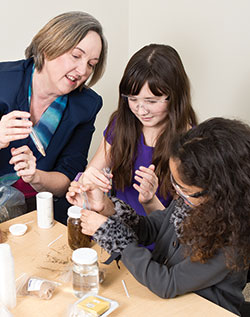
Developed by Corinne Rutzke, M.S. ’98, Ph.D. ’00, a senior research associate in biological and environmental engineering, and co-author and inventor Michael Rutzke, Ph.D. ’01, a senior research associate in crop and soil sciences, the Biomass to Biofuel Kit for Advanced Placement students challenges students to design their own scientific experiments in converting plant matter to ethanol biofuels.
“Just as space exploration inspired learning in the 1960s and beyond, the global environment and bio-based solutions inspire learning today. Agricultural, bio-based topics are an excellent platform for education because agriculture offers both touchable, recognizable, relevant aspects of everyday life, and abstract-thinking challenges that are at the cutting edge of science, engineering, technology and math,” said Corinne Rutzke, who also serves as the director of the Bioenergy and Bioproducts Education Programs funded through a grant from the U.S. Department of Agriculture. “We are hoping that access to this tool, and others like it, will help teachers engage students in math and science.”
The biofuels kit guides students in running a five-day experiment in 40-minute classes, evaluating how factors such as pH and heat affect the digestion of cellulose into glucose, the building block for ethanol biofuels. The lessons, geared toward high school students in Advanced Placement sciences classes, also demonstrate that scientific experiments do not always need to be elaborate and expensive. Students can go anywhere, even their own backyards, to find plant biomass raw material—such as grass and leaves—for the experiment, Corinne Rutzke said.
After a prototype kit was vetted by local science teachers, Corinne Rutzke turned to CTL to scale up and market the kit through a licensing agreement with the Carolina Biological Supply Company. CTL, a university-wide technology transfer service, assists faculty, staff and students in bringing ideas and products to the marketplace through help with licensing, marketing research and industry networking events.
“Our goal is to transfer Cornell ideas to the market to benefit the world,” said CTL technology licensing officer Jeff Fearn ’82. “Not every product idea has to be high tech. The AP Bio Kit is an example that’s really unique and has a lot of potential benefit to students.”


