

As I look ahead to my second term as dean of Cornell University’s College of Agriculture and Life Sciences, I also find myself reflecting upon the college’s recent accomplishments. In June 2014, we launched the School of Integrative Plant Science with the goal of enhancing Cornell’s leadership in plant, soil and related microbial sciences. More recently, we were deeply gratified by U.S. News and World Report’s recognition of Cornell as the Best Global University for Plant and Animal Science, highlighting our world-renowned academic leadership across these critical disciplines. Bloomberg Businessweek identified the Charles H. Dyson School of Applied Economics and Management as having the top-ranked undergraduate business program in the Ivy League and ranking third, overall, in the nation. In the past few years, the number of applicants to our undergraduate programs has reached record highs across the college, yielding the most diverse student population in CALS’ history. New experiential learning opportunities have been launched for students, and multiple curricula have been completely revamped, including the Fall 2013 initiation of the new interdisciplinary environmental and sustainability sciences major. We are nearing completion of the Stocking Hall renovation and will be celebrating completion of the Warren Hall renovation later this spring. These accomplishments were made possible through the support and commitment of our faculty, staff, university leadership, students, alumni, state stakeholders and other friends of the college.
Our recently completed strategic plan addresses many grand challenges that face our world today, from local to global scales, in the life sciences, the environmental sciences, in social sciences, and across food and energy systems. Our faculty, staff and students are already taking on many of these challenges. For example, the feature on big data shows the revolutionary ways we are harnessing new information science tools to probe the dynamics of public discourse and refine climate predictions to help protect vulnerable crops. Fifty years after Cornell pioneered the field of chemical ecology, our scientists continue to push the envelope in this discipline, thanks to new technologies and broad collaborations.
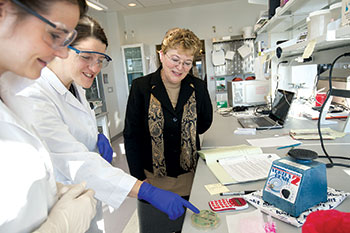
The core of our mission will always revolve around supporting our students, who—through our resources, technology and programs—will become society’s leaders of tomorrow. Because CALS is at the forefront of finding solutions to today’s most difficult and critical challenges, we are attracting the best and most diverse students from around the globe, as illustrated by the promising students and their distinguished faculty and staff mentors highlighted in the photo feature.
As always, thank you for your continued interest in and support of all that we do. This year of our Sesquicentennial Celebration coincides with one of the most exciting periods in the history of Cornell and CALS. Charter Day Weekend provides a perfect opportunity to return to campus to join in the many festivities. I hope to see you on campus during the upcoming celebrations!


