

Every Friday morning since 2004, the CALS Plant-Insect Group has met via conference call to share ideas and talk research. They’re a diverse bunch: entomologists, neurobiologists, ecologists, chemists and evolutionary biologists on the Ithaca campus and in Geneva, N.Y. Above all, they are chemical ecologists, working to decode the complex chemical signals bacteria, plants and insects use to communicate. These signals make up a lush information landscape that scientists are studying to better understand their function and how they can be used to fight human disease and deter agricultural pests.
Like the Plant-Insect Group, the field of chemical ecology—the study of the chemicals that mediate interactions between organisms—is interdisciplinary. Spurred by discovery of the first insect sex pheromone in 1959, researchers raced to identify other insect pheromones and their roles, hoping to harness them for pest control. In 1965, Cornell University took the lead when Paul Chapman, then chair of the Entomology Department at the New York State Agricultural Experiment Station in Geneva, brought together experts in chemistry, neurobiology and entomology to identify and interpret the heretofore hidden language of insects (see sidebar). Fifty years later, scientists at Cornell continue pushing the envelope on chemical ecology thanks to new technologies and broad collaborations.
Chemical ecology research today falls on a continuum; instead of focusing exclusively on one end—for example, studying just the chemical cues that attract pollinators or mates—researchers are increasingly looking at chemical signals from a systems perspective.
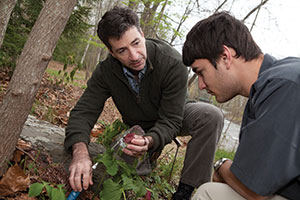
“Plant reproduction through pollination happens in the context of other things, like defending against pests—not in a vacuum. We need to study the whole plant to understand this,” said Robert Raguso, professor and chair of the Department of Neurobiology and Behavior.
Twenty years ago when Raguso began studying how moths find flowers to pollinate, most research focused on visual cues like flower color. But Raguso knew that some plants, like gardenias and jasmine, produced highly scented flowers; could their strong scent draw would-be pollinators? To test this idea, Raguso used hawk moths and a series of carefully designed experiments to see whether and how moths responded neurophysiologically to the airborne volatile organic compounds (VOCs) that flowers emit. He found that he could alter moth behavior by manipulating the VOCs of various flowers while controlling for other factors like flower color and form.
“Floral volatiles really matter, and they have highly variable functions: attracting pollinators, serving as insect ‘reminders’ for specific flower types, or repelling unwelcome visitors,” Raguso said.
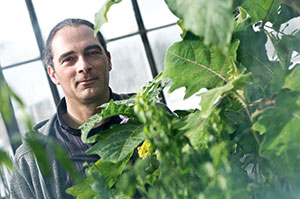
André Kessler, associate professor of ecology and evolutionary biology, is digging deeper into these functions by studying how insects induce chemical changes in plants they feed on.
“In the 1950s, scientists thought the secondary chemical compounds plants produce, which have no nutritional value to the plant, were a waste byproduct of photosynthesis. But many were toxic, so it was suggested they may have a defensive function,” Kessler said.
After extensive studies examining the wound and infection process inside plants, scientists found that these compounds are in fact primarily used to fend off pests or mount a defense against infection. Further studies found that plants also release different volatile chemicals when damaged by plant-eating insects. In 2001, Kessler published research that partially explained why. He found that not only do the plant volatiles that damaged plants release signal nearby plants to ready their direct defenses for an impending attack—for example, by increasing toxin or sap production—they also serve as alarm calls for insect allies to come to the plant’s indirect defense.
Many natural enemies of plant-eating insects have close mutually beneficial relationships with plants, which offer food or shelter in exchange for predators’ pest-eating services. In a 2011 paper, Kessler concluded that these resources—not the plant’s volatile chemicals—were the evolutionary impetus for such mutualisms. This is because broadcasting a chemical alarm isn’t always directly beneficial to plants.
“We found instead that the induced response—these VOCs—was just being released into the environment for whoever could read it. Plant-eating insects are major agents of natural selection on the chemical transfer of information to all organisms,” Kessler said.
Many insects subvert plant alarm signals to find hosts and overcome their natural defenses. For example, bark beetles are attracted to damaged pine trees by the VOCs they emit and by the specific pheromones the beetles emit calling for a mass attack. But if a tree’s emissions are too high, beetles will avoid it because this signals a tree that’s better defended.
Nature is replete with these interspecies spy games. Raguso cites several examples of flowers that look and smell like rewarding treats for insects but have no nectar.
“Some orchids smell like a female bee or wasp in heat, so male insects try to copulate with the flower. There are also flowers that smell like rotting flesh or feces and fool female insects to laying eggs in these places, during which they transfer pollen between these deceptive flowers,” Raguso said.
This is where scientists get into the game, eavesdropping on chemical conversations to manipulate the behavior of insect pests in crop systems. Since their discovery, scientists have created and used synthetic pheromones to attract pests to monitoring traps and disrupt their mating behavior. Mating disruption has been especially successful. By randomly releasing pest-specific female sex pheromones into a field, males are inundated with signals and unable to locate mates. Kessler calls it one of the best working chemical ecology applications.
Growers also use pheromones to monitor pest populations in their fields to better time and reduce pesticide spraying. Lures can be a combination of insect sex and aggregation pheromones. But researchers are finding that paying attention to the full information landscape, not just insect signals, may offer better solutions.
“If we can understand the chemical ecology of how plants and insects interact, how insects are using these volatile signals, we can exploit them to deter pests and find more sustainable tools for farmers,” said Greg Loeb, professor of entomology.
Loeb specializes in small berry and grape entomology and studies how to use insect and plant volatiles to control some of New York’s worst pests. For the past five years, he’s been working to find a chemical cocktail to attract female grape berry moths. Loeb and his colleagues, chemist Wendell Roelofs (now retired) and entomologist Charles Linn, already had synthetic pheromone lures to attract males, but monitoring them wasn’t providing growers much actionable information. This was because the greatest damage was being done by the second and third generations of moths; monitoring females and their life cycle would give growers a much better read on when action was needed.
So the team started looking at context, turning to the kairomones emitted by grapevines as possible candidates. While pheromones are chemicals that organisms release to elicit a response in members of their own species, kairomones are chemical signals between species—often released to the benefit of the receiver but the detriment of the sender. Since the grape berry moth, like many other insect pests, is a host specialist—feeding and laying eggs mainly on grapes—Loeb assumed that chemical signals from grapevines were attractive.
After culling through 20 potential compounds, Loeb, Roelofs and Linn finally found a unique blend of seven being emitted from healthy grapes that attract male and female grape berry moths.
“We expected to find a unique signal, and we did. But we didn’t find a unique compound,” Loeb said.
Instead, the moths located grapevine hosts by tuning into a subset of common plant volatiles when present in specific ratios. While the chemical blend doesn’t work sufficiently well as a lure to be practical for growers, Loeb is encouraged about next steps.
“As we learn more about the genetic and molecular basis of these compounds, we may be able to breed plants to make them less chemically apparent to pests, or even repellent, based on the chemicals they emit,” he said.
The finding that VOCs emitted by plants can attract or repel certain pests is central to the development of “push-pull” systems of pest control. In such systems, pests are “pushed away” from cash crops by repellant plants, then pulled toward and “trapped” in highly attractive species growing around the cash crop. The system was pioneered in 2000 by the International Center for Insect Physiology and Ecology in Kenya, working with smallholder farmers to protect their corn crops from a stem-boring pest.
For Kenya’s subsistence farmers, synthetic insecticides are both too expensive and ineffective against stem-boring larvae. By intercropping a repellant legume with their corn and planting a type of local grass around the crops as a trap, farmers controlled the pests so well that Kessler said the crops looked like they’d been conventionally sprayed. Scientists also found that the repellant legume emitted chemicals into the soil that tricked parasitic witch weed seeds into moving toward its roots instead of the corn’s, resulting in the seeds’ “suicide germination” near these non-host plants.

In Colombia, Katja Poveda, assistant professor of entomology, has developed a push-pull system for potato farmers to combat the tuber moth. She first tested different varieties of local potatoes, screening them to find one whose chemical signals were more attractive to the moth than the kind farmers were growing. By intercropping with this variety and spraying with garlic and pepper extract, the system reduced damage to the potatoes at the same rate as insecticide sprays. But Poveda’s further studies found that the system’s success varied by location; at some sites it decreased pests, but at others it attracted them. Again, as chemical ecologists are finding, success hinges on context.
“The success of local practices, such as using trap plants for pests or using a flowering plant to attract pollinators or predators to a field, depends on the local and surrounding biodiversity. The current theory suggests that farms surrounded by some natural areas will profit the most from local management practices, and we’re currently working in cabbage, strawberry and potato to test if this is true,” Poveda said.

Studying the broader information landscape of insects and plants is unlocking another novel method of pest control: fear. While most biocontrol pest management programs focus on introducing predators into fields to eat pests, Jennifer Thaler, associate professor of entomology, has found that this method can have a bigger effect if prey can sense the presence of predators through chemical signals.
Working with beetles and caterpillars, Thaler found that when predatory insects are released into a field of plant-eating insects, 85 percent of the reduction in plant damage is because the predator is present, not because the pest got eaten. This effect spanned generations, with the offspring of scared insect pests laying fewer eggs that hatch into larvae that eat less and grow more slowly.
“We really need to pay attention to these fear factors. We see long-term, cross-generational consequences of being exposed to a predator,” Thaler said.
Paying attention to chemical communications in context has led at least one CALS scientist into groundbreaking territory.
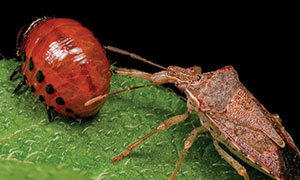
During his postdoctoral research, Stephen Winans, professor of microbiology, was studying how Agrobacterium—a model organism for studying plant disease—was able to perceive wounded plants by detecting diffusible chemicals released from wound sites. While investigating this, Winans had another idea: Could this bacterium also use chemical signals to detect sibling bacteria? In the early 1990s, Winans and his team became the first to demonstrate that Agrobacterium produces pheromones and uses them to coordinate cell functions.
“These bacteria synthesize specialized pheromones all the time and release them into the environment, but these chemicals accumulate to detectable levels only when large populations of bacteria are present. The bacteria therefore use these molecules to estimate their population density for coordinated behaviors,” said Winans, who popularized the term quorum sensing to describe the phenomenon.
Today, Winans studies similar signaling systems in other bacterial families, learning as much as possible about the mechanisms behind them. His research has already led to new treatments for life-threatening infections caused by antibiotic-resistant Staphylococcus and Pseudomonas aeruginosa.
“We can exploit these systems for medicine by using the pheromones to direct genes involved in the biological mechanisms that cause disease, or by using pheromone mimics to interfere with their communication,” Winans said.
Discoveries like Winans’ and those of other CALS scientists are painting a very different picture of our natural world. Instead of passive plants, we find active players coordinating their responses and those of the insects around them. Instead of automaton microbes, we find a team of single-celled organisms working toward their deadly goals. Chemicals are the common language.
And though scientists have yet to demonstrate whether human pheromones play key roles in coordinating our behavior, inside CALS, something is definitely in the air.
“New ideas come from being in this environment with students and faculty in other graduate fields every week,” Raguso said. “We are led in directions that we would never have gone in our individual labs.”


