To streamline the breeding of five staple crops—wheat, rice, maize, sorghum and chickpea—the Bill & Melinda Gates Foundation has awarded Cornell $18.5 million for a project that will put modular, open-source breeding software resources into the hands of plant breeders in the developing world.
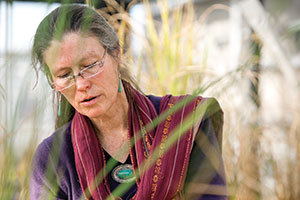
“This is a significant moment in the history of breeding, with genomes making their way into the heart of applied plant improvement,” said Susan McCouch, professor of plant breeding and genetics and the project’s principle investigator. “We can finally use genome-wide approaches to model plant performance in real time using tools that are shared across diverse species and regions of the world.”
The Genomic and Open-source Breeding Informatics Initiative (GOBII) takes aim at a hurdle created bythe era of genomics: big data. According to McCouch, millions of data points are being accumulated on hundreds of thousands of new breeding lines—the basis for new varieties—in breeding programs run by CGIAR, a consortium of 15 research centers around the world. The centers are populating databases with genetic profiles—the genotypes—as well as breeders’ observations on traits—or phenotypes—that will make or break harvests in the coming century. The databases will include information about drought tolerance, disease resistance and yield.
“No one can handle the volumes of data. Massive quantities of phenotype and genotype data are overwhelming to most public sector breeding programs,”
McCouch said. “On this project, we think of ourselves as the back office. The grant allows us to move forward with what’s essentially a service project to develop and deliver useful tools and information to public sector breeders around the world.”
GOBII will bring together software engineers and geneticists with plant breeders at three CGIAR centers in Mexico, India and the Philippines. Ithaca collaborators on the grant include Mark Sorrells, professor of plant breeding and genetics; Lukas Mueller, Boyce Thompson Institute associate professor; Qi Sun, Computational Biology Service Unit senior research associate; and Ed Buckler and Jean Luc Jannink, USDA Agricultural Research Service geneticists.
Together they will develop databases and software tools that will allow breeders to use genomic information from start to finish, from identifying diverse farmers’ needs, to developing analytical tools to help breeders make selections among breeding lines, and ultimately integrating the new tools into existing information systems used by each CGIAR center.
“What we hope to do is help breeders make selections more efficiently, using genomics to eliminate breeding lines with poor breeding value, and increase the probability of finding what they want,” McCouch said. “Ultimately, our goal is to increase the rate at which smallholder farmers in the developing world benefit from advances in the application of genomics to plant breeding.”