By Celina Scott-Buechler
Landscape architecture, says Maria Goula, is where the natural and social sciences intersect.
Goula, a new associate professor at CALS, recently moved here from her post as vice dean of Landscape Architecture Studies at the Barcelona School of Architecture. Having done her undergraduate studies in Greece and received her master’s and Ph.D. in Barcelona, Spain, she said she brings a Mediterranean perspective to Cornell’s Landscape Architecture program.
“I look at the way humans use their environment and how their environment in turn affects them,” Goula said.
She’s working and teaching a studio course on the design of “resilient landscapes along torrential rivers” in Barcelona. Because of its location on the Mediterranean Sea, Barcelona’s climate is extreme when it comes to rain: the city doesn’t often get it, but when it does it’s in cataracts. Climate change is only exacerbating these cycles, so cities in the region are increasingly exposed to periods of drought directly followed by flooding.
“The city wasn’t built to handle the torrents,” she said. “What it does is canalize it, which is really a waste.”
Goula said the bulk of the rain the city gets flows into a network of large, concrete canals that redirect it away from the city. The problem with this is twofold, she said. First, these canals often can’t contain the amount of water pouring into them. Second, the city really can’t afford not to be collecting and putting this water to municipal use.
“I look for alternative uses of the water,” she said. “Creative coastal landscape architecture is increasingly crucial to the Mediterranean region because it’s experiencing significant population growth, both seasonally and annually.”
The focus of her work is using parks as “systems of green spaces that reveal torrents.” By strategically planning and building parks where rainwater will naturally flow, landscape architects can both prevent flood damage to cities and capture water that would otherwise be wasted.
“Plus,” she said, “not using the land for parks is a missed opportunity for neighborhoods to create green public spaces that bring people together.”
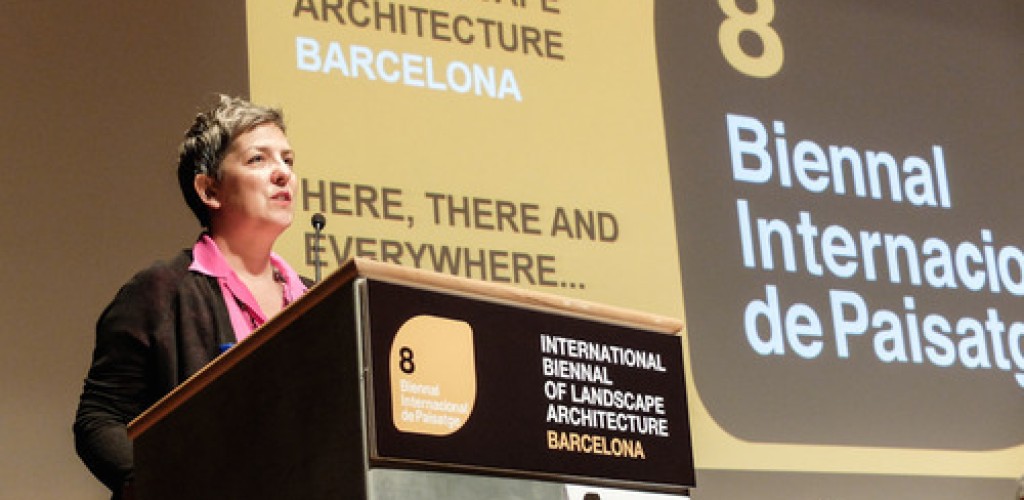
Goula stressed the importance of collaboration, not only to her individual projects, but to the field as a whole. For the past 15 years she’s been involved in a symposium that brings together innovators in the field of landscape architecture from around the world – the European (now International) Landscape Biennial in Barcelona.
“My hope is to bring this creativity to my students,” she said. “It’s the intersection of landscape designers, architects and planners, giving the collaborative work that comes out of these biennials incredible depth and ingenuity.”
Goula said the college’s combination of undergraduate and graduate programs in Landscape Architecture, and its heavy emphasis on faculty-student collaboration, is what drew her to Ithaca.
“And it’s certainly impressed me enough to stay,” she said.
Celina Scott-Buechler is a student writer in the College of Agriculture and Life Sciences.