What is the best way to conserve biodiversity in Ecuador’s Andes Mountains?
Start with the bears.
A Cornell research team is joining local efforts in Ecuador to help design a socio-ecological corridor that could help save endangered, threatened and endemic species in that country’s Andes region.
The team is headed by Angela Fuller, leader of the New York Cooperative Fish and Wildlife Research Unit and assistant professor in the Department of Natural Resources at Cornell.
Ecuador’s mountain forests are a hotspot of rich biodiversity, but many of those species are threatened by increased deforestation and fragmentation due to activities such as agriculture and cattle ranching. In 2013, the Secretary of the Environment of the Quito Municipal District established an ecological corridor and conservation program for the endangered Andean bear in the northwest area of the district. Easily recognized by its distinctive facial markings, the Andean bear—also known as the spectacled bear—is considered an “umbrella species,” in that it has large spatial requirements and similar habitat needs as other mammalian species of conservation concern in the region, such as jaguars, pumas, margays and ocelots, as well as numerous endemic bird and amphibian species.

Based upon the initiative of multiple local organizations, Fuller’s team is providing science support to the local effort to help expand the designated ecological corridor in Quito — established through a municipal resolution — to connect with the Cotacachi-Cayapas Ecological Reserve to the north and the Illinizas Ecological Reserve to the south. Taken together, the entire areas could extend up to 200 kilometers along the western range of the Andes. The exact size and location of the corridor will depend on a number of key issues: connection of existing reserves within the potential corridor, biodiversity, sustainability, economic stability of local communities and social acceptability.
”The idea is to identify areas that could connect the ecological corridor for the Andean bear to the two existing reserves to the north and the south. The optimal design of this corridor is a large collaborative effort that would integrate the ecological, social and economic concerns within the region,” Fuller said.
In addition to conserving biodiversity, the project will also consider ways the corridor could positively impact the livelihoods of the surrounding communities by exploring financial incentives and productive alternatives for landholders to conserve and reforest their land. Alternatives include payment for ecosystem services, conservation easements, agroforestry, shade-grown coffee and ecotourism. Many of these alternatives have already been initiated and provide a strong basis for further development.
“Local communities still need to engage in activities that provide income,” Fuller said. “So there are many creative ways we can think about activities that are compatible with conservation, while still providing income.”
Undertaking such a multifaceted project requires an interdisciplinary approach that is reflected in the diversity of Fuller’s team, which includes Professor of Computer Science Carla Gomes; Department of Natural Resources Professor Jim Lassoie; professor Greg Poe, who specializes in non-market valuation and environmental policy in Dyson School of Applied Economics and Management; and Dr. Andy Royle, a research statistician with the U.S. Geological Survey’s Patuxent Wildlife Research Center.
The Cornell team is helping in the design the corridor, by first estimating the number of Andean bears and learning more about their movements and resource use. The team is working with University of San Francisco de Quito researcher and Andean bear expert Santiago Molina, who has set “camera traps” at various sites throughout the mountains. Spatial capture-recapture models will be used to estimate bear density and landscape connectivity for the potential corridor.
“We’re going to let the bears tell us what the connectivity is,” Fuller said. “Estimating landscape connectivity directly from the observed pattern of bear detections is in contrast to the more typical approach of experts suggesting values that represent how resistant different landscape types may be to a bear moving through.”
In the near future, they will begin adding other components to the project such as metrics related to endemic bird species and possibly even rare orchids. These will be used to broaden the relevance of the corridor beyond that which just Andean bears alone would provide. For this work the team will be collaborating with Associate Professor and Director of Conservation Science Amanda Rodewald and eBird Project Manager Chris Wood with the Cornell Lab of Ornithology.
The team is also collaborating with social scientist Dr. Carlos Larrea from the University of Andina Simón Bolívar, who will help in addressing community support and alternative livelihood strategies. Another key collaborator is Jefferson Mecham, an agroforestry specialist with more than 20 years of consulting experience in Ecuador including the establishment of community-based protected forest areas within the corridor.
Importantly, the team will be collaborating with surrounding communities and parishes, local conservation groups, other university researchers, and the Secretary of the Environment of the Municipal District of Quito.
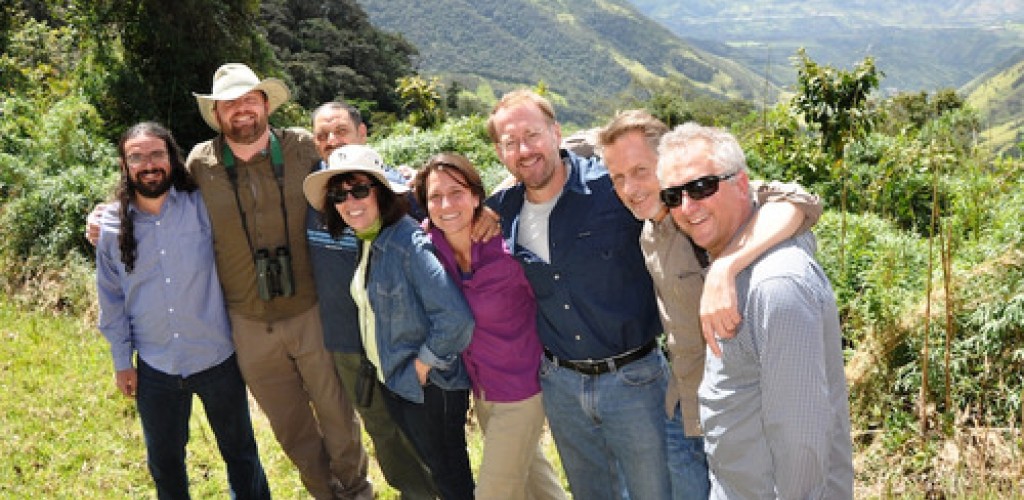
In January, Fuller and her team traveled to Ecuador for a week to begin meeting with project partners and local stakeholders. The team ventured into the cloud forests with Molina, who coordinates the natural corridor and the conservation program for the Andean bear, and they got a firsthand look at the challenges of studying the species.
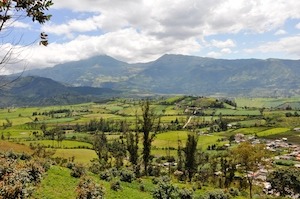
"It’s very time intensive to do work in this area,” Fuller said. “Because of the high elevation mountains, rugged terrain, and limited trail and road access. You can place a trail camera on top of a mountain ridge, but it will take you an entire day to go check on it.”
The team, which is currently funded through a $130,000 Academic Venture Fund grant from the Atkinson Center for a Sustainable Future at Cornell, hopes to return to Ecuador in the early summer. AVF grants provide seed funds for multidisciplinary projects that have potential to engage partners beyond campus. In order to undertake the research needed to design such a socio-ecological corridor, additional grant funding over an extended time period will be needed. For now, the team is working with its Ecuadorean partners to better understand the various ecological, social and economic issues at play, and turn them into objectives that can be quantified. Those quantifications will ultimately help in the design of the corridor, although Fuller cautions the entire process could take years, maybe even a decade, and is dependent on them securing additional funding for the work.
While Fuller was able to survey the bears’ habitat during her visit, she did not get a glimpse of any bears themselves.
“It’s like asking you ‘When is the last time you saw a black bear?’ They’re difficult to see,” she said. “And given they are an endangered species, there are so few of them.”