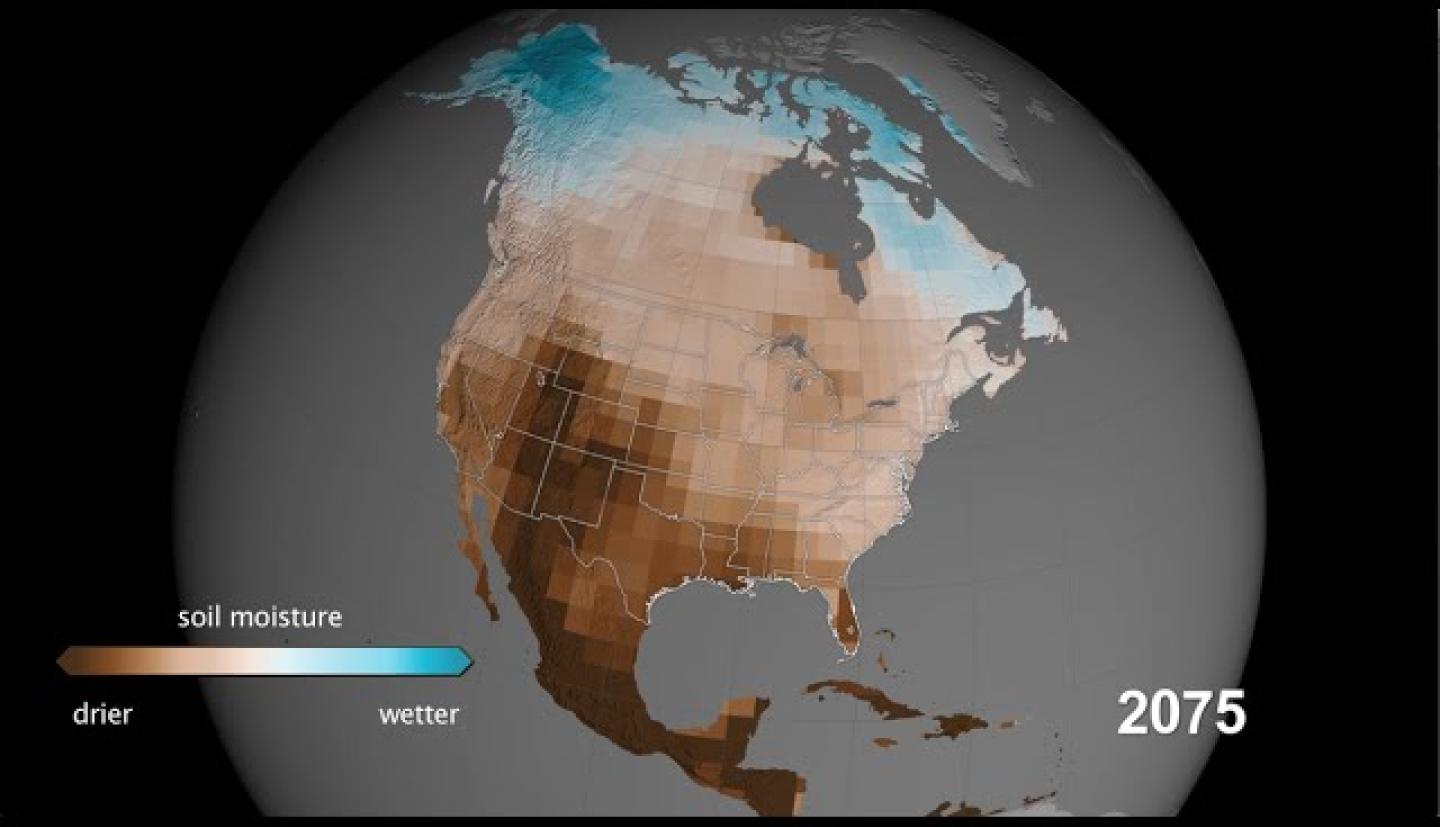
The consequences of climate change paint ableak picture for the Southwest and much of America’s breadbasket, the Great Plains.A “megadrought” likely will occur late in this century, and it could last for threedecades, according to a new report by Cornell and NASA researchers in thejournal Science Advances (Feb. 12), an online publication of the AmericanAssociation for the Advancement of Science.
“The results were striking. As a society, we’ve weighted the dice toward megadrought. Data clearly point to a high risk in the Southwest and Great Plains, as we continue to add carbon dioxide into our atmosphere,” said Toby Ault, Cornell associate professor of earth and atmospheric sciences. “However, if we manage to get serious about lowering greenhouse gases within the next 10 years, we could face a lower risk.”
With a drier future and higher regional temperatures amplifying possible late-century droughts, the situation presents a major adaptation challenge for managing the region’s water needs, explains Ault, who along with lead author Benjamin Cook and Jason Smerdon, both of NASA, published their new study, “Unprecedented 21st Century Drought Risk in the American Southwest and Central Plains Drought Risk in Western North America.”
By examining tree rings and other physical clues, previous research had identified a period of time called Medieval Climate Anomaly (A.D. 1100-1300) when megadroughts were more common. By analyzing data from 17 state-of-the-art global climate models, Cook, Ault and Smerdon learned that western North America’s future drought risk exceeded even the driest centuries of the Medieval Climate Anomaly.
The role of climate change in causing extreme heat waves, drastic rainfall, negative impacts on human health and threatened food security have received more attention recently than megadrought. However, Ault views prolonged drought risk as yet another natural hazard that becomes more likely from human activity.
“Hurricanes and tornadoes are natural hazards and they strike fast. A megadrought is a natural hazard, but it unfolds slowly – over a period of decades,” said Ault. “It’s just another natural hazard and one we can manage.”
Ault wants to lower carbon dioxide emissions quickly. “The time to act is now. The time to start planning for adaptation is now,” he said. “We need to assess what the rest of this century will look like for our children and grandchildren.”
The National Science Foundation and NASA funded this research. Ault was supported by a startup grant from the College of Agriculture and Life Sciences.
This article was originally published in the Cornell Chronicle.
The full study, “Unprecedented 21st Century Drought Risk in the AmericanSouthwest and Central Plains Drought Risk in Western North America,” is available online here.