Bolstered by a $2.3 million venture capital investment, an agricultural technology startup is moving on from its first home in Cornell’s life sciences business incubator, a little more than a year after it arrived.
Agronomic Technology Corp., which makes the software Adapt-N to help farmers optimize nitrogen fertilization, is the first fledgling business to “graduate” from the three-year-old Kevin M. McGovern Family Center for Venture Development in the Life Sciences.
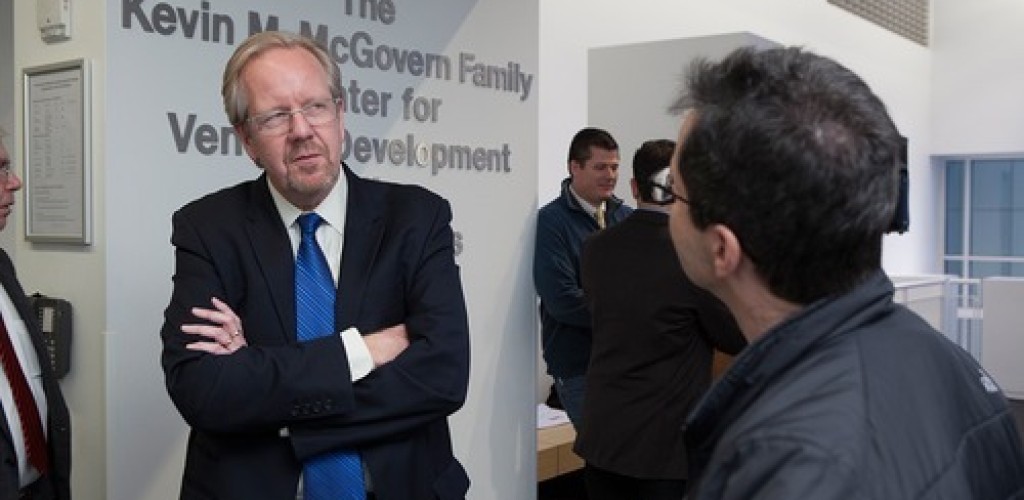
The occasion called for a celebration – a commencement of sorts – held Jan. 8 at the McGovern Center in Weill Hall, which included remarks by President David Skorton, company officials and others. Skorton noted that the McGovern Center, as well as the downtown Ithaca incubator Rev, reflect Cornell’s land-grant mission to benefit the public and, in this case, the economy of New York state.
Admitted as a McGovern client in December 2013, Agronomic Technology Corp. recently secured $2.3 million in capital investment from Cayuga Venture Partners, of which Cornell’s endowment is a limited partner; as well as Armory Square Ventures of Syracuse, New York, and Arthur Ventures of Fargo, North Dakota. The company is in the process of finding a permanent home as it seeks expansion, said co-founder and president Greg Levow ’04.
More than 10 years ago, Adapt-N originated in the lab of Harold Van Es, Cornell professor of soil and water management, who remains a scientific consultant for the company. In Van Es’ lab, Adapt-N was tested in thousands of farmers’ fields in several states, thanks to the support of federal and private grant funding. After licensing the product through the Cornell Center for Technology Enterprise and Commercialization, Van Es connected with Levow, Steve Sibulkin and Holly Trytten, who together co-founded Agronomic Technology.
Adapt-N simulates the nitrogen cycle, utilizing soil, weather, crop and field management data to provide field-specific nitrogen recommendations for corn farmers. It provides financial as well as environmental benefits.
Taking science out of the lab and into the marketplace involves many complex moving parts, noted McGovern Center Director Lou Walcer.
In Agronomic Technology’s case, “the university’s technology licensing did things right, Harold [Van Es] as a scientist did things excellently, the center did its part right, and the Agronomic Technology team did their part excellently,” Walcer said. “And now they’re on their way.”