

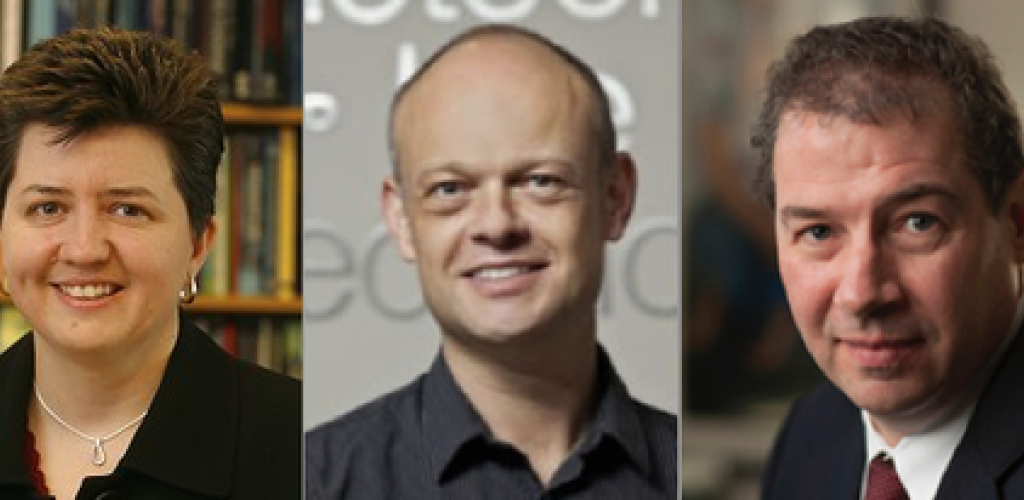
Three faculty members with deep CALS ties – Earth and Atmospheric Sciences Professor Sara Pryor, Plant Biology Professor Jocelyn Rose and Division of Nutritional Sciences Director Patrick Stover – were among an elite seven from Cornell University elected this week to be fellows of the American Association for the Advancement of Science (AAAS), the world’s largest general scientific society.
AAAS elected 401 new fellows for 2014, honoring them for contributions to innovation, education and scientific leadership. Their accomplishments will be celebrated at the 2015 AAAS Annual Meeting in February.
Here’s the complete list of Cornell’s 2014 AAAS fellows, courtesy of the Cornell Chronicle:
- Sara Pryor, professor of earth and atmospheric sciences, who seeks to improve understanding of the climate system through the use of a combination of field measurements and numerical tools;
- Jocelyn Rose, professor of plant biology and director of Cornell’s Institute of Biotechnology, who studies plant cell wall biology and seeks understanding of its societal importance;
- Patrick Stover, professor and director of Cornell’s Division of Nutritional Sciences, who studies biochemical mechanisms that underlie pathologies with interactive genetic and nutritional components;
- Lance Collins, the Joseph Silbert Dean of the College of Engineering and professor in the Sibley School of Mechanical and Aerospace Engineering, whose research is in the application of direct numerical simulation in a broad range of turbulent processes;
- Katherine Hajjar, the Brine Family Professor and chair of the Department of Cell and Developmental Biology at Weill Cornell Medical College, who leads research in the intersection of hemostasis and angiogenesis, the functions of cancer-causing genes, and other fundamental biological questions that relate to human health and disease;
- Christopher Ober, the Francis Norwood Bard Professor of Metallurgical Engineering, whose research focus is creating new polymeric materials and refining their properties with a fundamental understanding of their physical behavior; and
- Marjolein van der Meulen, the James M. and Marsha McCormick Chair of Biomedical Engineering, the Swanson Professor of Biomedical Engineering, and a professor in the Sibley School of Mechanical and Aerospace Engineering, whose work is in orthopedic biomechanics focusing on the interaction between mechanical stimuli and the skeleton.


