It was a dream come true for Bryan Caldwell, a research scientist and space physiologist who works as a postdoc in the lab of biological and environmental engineering associate professor Jean Hunter: a mission aboard the zero-gravity G-Force 1 space simulator to conduct the first partial gravity cooking experiment on record.
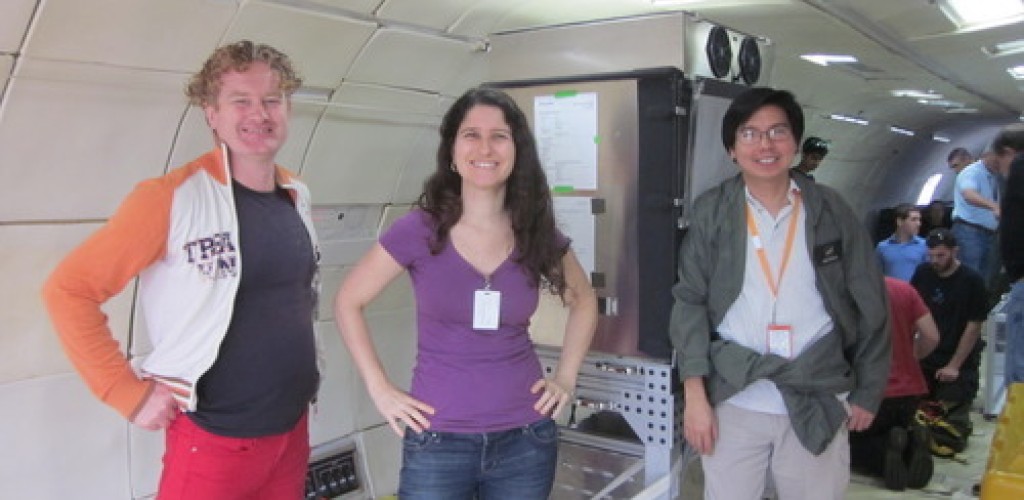
Caldwell (pictured left, with fellow Cornell postdoc Apollo Arquiza, far right, and Susana Carranza of Makel Engineering, center) was in New York City recently to share some of his experiences – and the results of bed rest studies he has conducted to test the effects of simulated weightlessness on smell and taste perception - with members of the media as part of an Inside Cornell event.
The New Zealand native is now over the moon to learn he has been selected as one of a four member crew for a seven-day Human Exploration Research Analog (HERA) asteroid landing simulation mission at Johnson Space Center, scheduled for early September.
“I’ve been involved in analog research and this is a wonderful opportunity as a researcher to experience what our subjects experience. I guess I’m the lab rat now,” Caldwell said.
According to the NASA blog, previous missions involved behavioral health experiments to determine how confinement and isolation impacts cohabitation, teamwork, team cohesion, mood, performance and overall well-being among participants cramped into the 148-cubic-meter simulator - just enough space for four bunks, a work area, a hygiene area and an airlock.
They were assigned operational tasks similar to those performed by astronauts on the International Space Station; however, the tasks were modified to emulate what might be required on a mission to an asteroid. They included general housekeeping, maintenance and systems tasks, education and outreach activities, daily planning conferences, and family and medical conferences. Crew members also conducted payload objectives (experiments) related to biology, geology and robotics; participated in onboard training; ate the same food as crew members aboard the space station; and exercised.
Learn more about the mission here.