

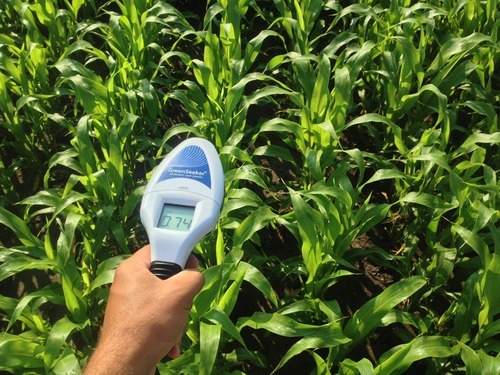
Last week I started on my own personal project for my internship. I’ll be making a fact sheet that will be available to the public about a tool called the GreenSeeker. This tool emits an infrared beam onto the ground and measures the light that is reflected back. Basically, you pull and hold the trigger, walk any distance while holding it over the row, and it gives you that row’s average number, anywhere from zero to one. The higher the number it measures, the healthier the plants are. The tool also comes in a few different forms. I’m using a hand-held model for my project, but you can also mount as many as you want on a vehicle (tractor, truck, four wheeler) to measure fields on a larger scale. For example, a few GreenSeekers mounted on a nitrogen side dresser could collect real-time data, and then fertilizer rate adjustments could be made on the fly based on crop health at any point in the field.
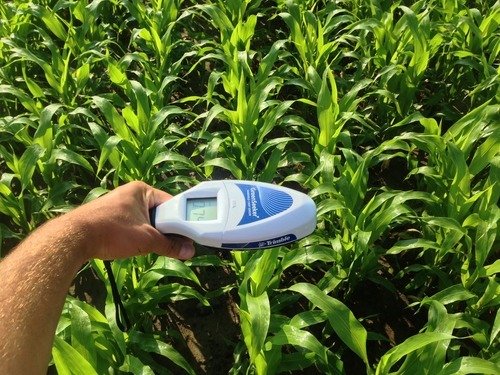
My project, however, is actually observing different measurement methods that you can use with the GreenSeeker. I’m testing to see how holding the tool different ways affects the reliability of the measurements that are taken. I’m testing two main factors: height of the tool and direction of the tool. As of now, a standard height of 48 inches off the ground is used by most people, but I’m testing a new height. It’s calculated by adding 36 inches to the field’s average plant height. The direction of the tool is the second element. Instead on holding the tool parallel to the row while going over it, I’m turning the tool 90 degrees so that it’s perpendicular to the row.
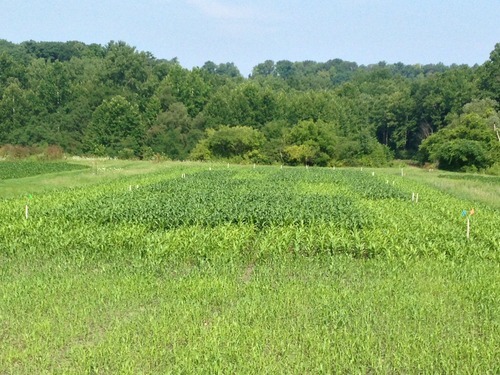
I’m testing two different locations with four repetitions of five treatments in each, for a total of 40 plots to go through. The plots have sorghum growing in them that were started with five different rates of nitrogen fertilizer. I measure the middle three rows of each plot four different times. This is because I walk through each row holding the GreenSeeker parallel and low, parallel and high, perpendicular and low, and perpendicular and high. This makes for a lot of walking by the end of the day, but I believe it’ll be some very useful information that could help farmers better utilize this innovative tool.
—Tyler Pardoe ‘15 is senior in the Agricultural Sciences major interning with the Cornell Nutrient Management Spear Program. Read more about Tyler’s summer internship experiences, and those of his fellow students, on the Agricultural Sciences Interns blog.


