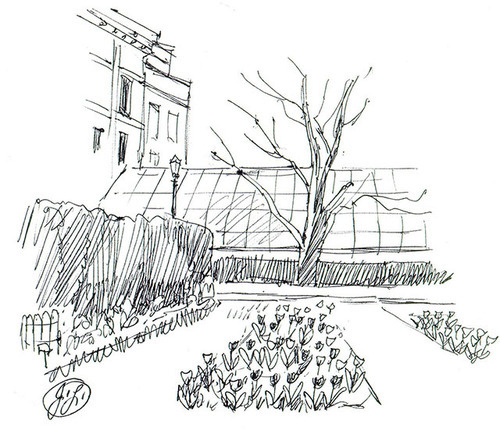
Robert J. “Jack” Lambert Jr. ’50, professor emeritus of freehand drawing, died August 8 at Kendal at Ithaca. He was 86. The beloved professor nurtured the artistic abilities of innumerable students, especially those studying landscape architecture and design, as head of the Freehand Drawing Program once housed in the Department of Floriculture and Ornamental Horticulture. He taught for more than 45 years, and even his retirement in 1997 didn’t stop him from sharing his love of drawing with others who took part in weekly lunchtime art classes. His artwork has been exhibited in numerous galleries, museums and juried shows, and is included in many publications and private collections. He also planned and supervised the construction of a rock garden at Cornell Plantations.
“Jack inspired generations of artists who now engage in all walks of life, from the life sciences, to communications, marketing, medicine and a host of other disciplines,” said Marcia Eames-Sheavly, senior extension associate/lecturer in the Horticulture Section of the School of Integrative Plant Science. “He taught the power of keen observation, and encouraged students to pause to record nature’s beauty everywhere. He possessed a wry wit, strong opinion, and a unique lens through which he viewed the world.”
Read more about his life on the Horticulture blog, or visit his memorial page.