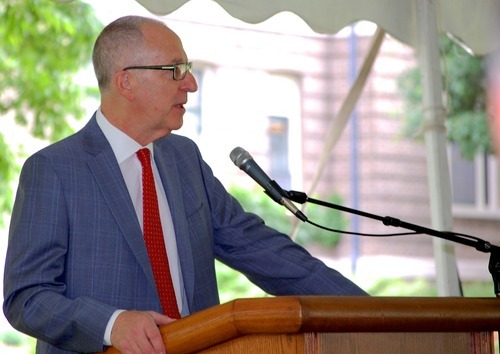
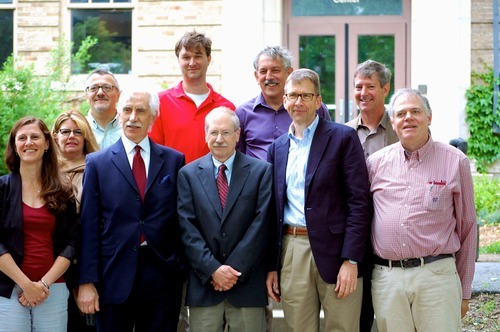
Cornell President David Skorton joined Dean Boor and a host of other dignitaries and Reunion attendees on the Ag Quad today to help launch the new School of Integrative Plant Science in CALS.
The school brings together CALS’ former plant and soil science departments (now “sections”) – Plant Biology, Horticulture, Plant Breeding and Genetics, Crop and Soil Sciences, and Plant Pathology and Plant-Microbe Biology – in one administrative unit. It was conceived by a group of faculty members who spent a year examining the current configuration of the plant sciences at Cornell. They envisioned a school that would provide coordinated administrative functions while maintaining the unique identities of its units and allowing the college to be more nimble in responding to wider scientific trends and societal needs in plant science.
At this morning’s event, President Skorton emphasized the important role the new school will play in helping Cornell to fulfill its Land-grant Mission of service to the state, nation and world.
“Some of the most challenging global issues call for creative leadership in plant science,” he said. “Food security, climate change, conservation of biodiversity, the balance of ecosystems—all these complex and difficult challenges require expertise and innovation in plant science… The creation of the School of Integrative Plant Science is a step toward increasing the impact of the very high level of expertise that CALS has in this area.”
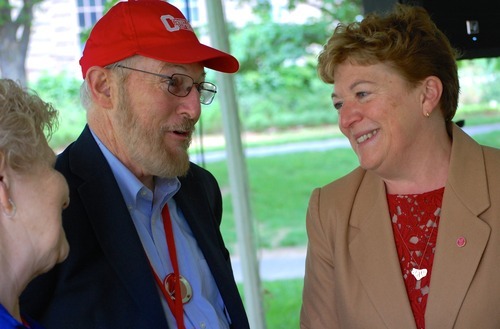
Calling the launch an “important milestone in the evolution of plant, soil, and microbial science research, teaching and extension work in CALS,” Dean Boor emphasized that the school will create a new face for these fields at Cornell, raising their profile to a level equal to their global importance.
She also pledged that the college would be making significant new investments to ensure the success of the school. These include new faculty hires, two new teaching laboratories in the Plant Science Building and a major greenhouse renovation project that would eliminate or replace older, energy inefficient greenhouses with state-of-the-art structures. Boor emphasized that the utility savings from these renovations would be reinvested in strengthening the programs within the school.
In addition, she announced that the college would establish a new Plant Transformation Facility in Weill Hall.
“This new center will offer genome-editing services using state-of-the-art technology to enable Cornell scientists to explore and manipulate the genetic blueprints of plants,” Boor said. “This kind of work holds great promise for generating important new discoveries in fundamental and applied plant science research.“
The school will also offer a plant science major with concentrations that include plant genetics and breeding; sustainable plant production and landscape management; evolution, systematics and ecology; plant physiology and molecular biology; and plants and human health. In addition, school faculty members contribute to several other undergraduate majors, such as agricultural sciences; viticulture and enology; biology (with a plant biology concentration); and international agriculture and rural development, as well as many minors, such as horticulture, crop management and soil science.
You can read more about the new school here.