From Margaret Tuttle McGrath, Department of Plant Pathology and Plant-Microbe Biology, Long Island Horticultural Research & Extension Center:
Reminiscent of the late blight outbreak of 2009, basil plants with downy mildew are being found at big chain garden centers on Long Island, New York as well as in Connecticut, New Jersey, Tennessee, Wisconsin, and several locations in Ontario. And I’m getting reports of the disease from gardeners, in some cases associated with purchase of locally-produced plants at local nurseries rather than big chains (one case here on Long Island). I’ve also gotten reports recently from Florida, Delaware, Virginia, West Virginia, Kentucky, North Carolina and a grower in Maine.
Please be on the lookout for this disease. If you have an opportunity to visit a garden center to look at basil, I’d appreciate hearing what you see. State inspectors here are done looking in garden centers.
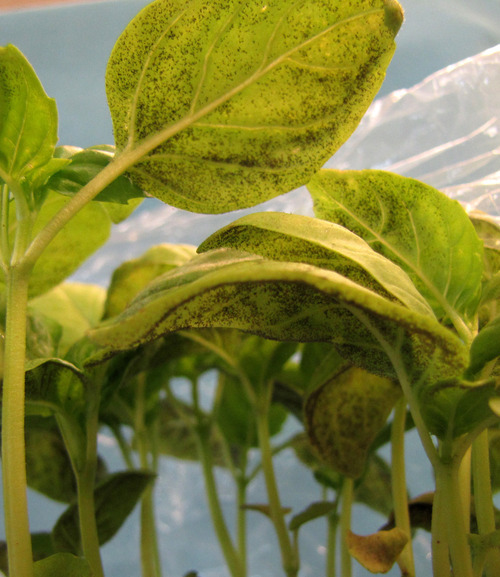
The above photo shows the typical symptom of a yellowing leaf (on right). Like the late blight pathogen on tomatoes and potatoes, this downy mildew pathogen produces an abundance of spores easily dispersed by wind, shown in image below.
Check out more images on the Vegetable Disease Photo Gallery website, as well as additional information at the Vegetable MD Online website.