

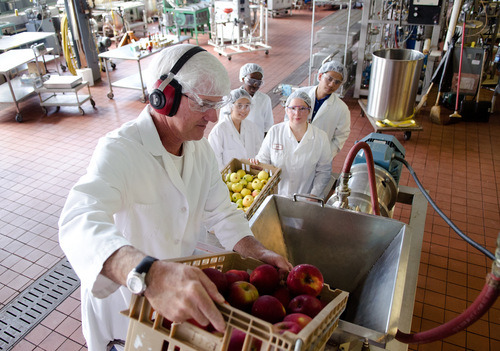
Yesterday, New York State Senator Mike Nozzolio announced that $3.4 million in new state funding would be allocated to the New York State Agricultural Experiment Station in Geneva, NY, to modernize the Fruit and Vegetable Processing Pilot Plant. The plant, which is the cornerstone of the Northeast Center for Food Entrepreneurship, serves as a resources for regional food entrepreneurs looking for assistance in testing and developing new food products prior to their release on the market.
The center assists small-, medium- and large-scale food manufacturers in meeting regulatory, safety and stability standards necessary to sell their products to consumers. Since 2000, the center has helped to launch over 6500 products, which have generated approximately 2500 new full- and part-time jobs in the regional economy.
“We are extremely grateful to Senator Nozzolio for securing this significant funding for the Fruit and Vegetable Processing Pilot Plant,” said Dr. Tom Burr, the Goichman Family Director of the New York State Agricultural Experiment Station. “This funding will be transformational for the Food Lab and will help make essential modifications to ensure it remains a state-of-the-art facility.”
“We thank the Senator Nozzolio for his strong support of the College of Agriculture and Life Sciences and our programs in Geneva,” said Dean Boor. “This funding will be important for improving facilities on the Geneva campus and addressing the challenges and opportunities of New York’s food and agriculture industries.”


