

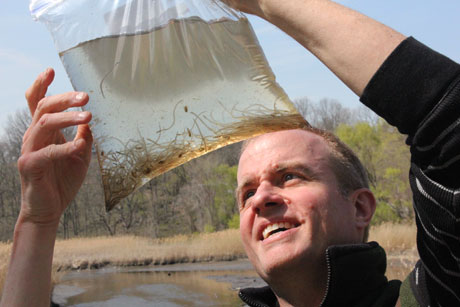
They may be small, but the so-called “glass eels” (Anguilla rostrata) are a key component of the river ecosystem. Chris Bowser, an extension support specialist for Cornell’s New York State Water Resources (WRI) Institute, has been using them as a teaching tool and conservation cause. He was recently rewarded for his efforts with a 2014 U.S. Environmental Protection Agency Environmental Quality Award.
“Chris has not only contributed to our scientific knowledge of eels and helped educate community members about eels, but through his citizen science eel project, he has fostered community engagement,” said Susan Riha, Charles L. Pack Professor in Earth and Atmospheric Sciences and director of WRI. “This is important to all of us who want to cultivate better participation and a greater public understanding of water resource management issues.”
American eels (Anguilla rostrata), a species in decline due to many environmental pressures, migrate from the Atlantic Ocean and enter freshwater estuaries including the Hudson River. Like the proverbial canary in the coalmine, eels are a good way to measure water system health.
From Mill Creek on Staten Island to Furnace Brook in Cortlandt and Hannacroix Creek in New Baltimore, Bowser engages hundreds of high school students, youth groups, college students and community volunteers to study glass eel migration in Hudson tributaries and promote stewardship of the fish.
“Eels are a great connector for all of New York’s waterways since they rely on the whole system, from small headwater streams and neighborhood creeks to big rivers and coastal estuaries,” Bowser said.


