

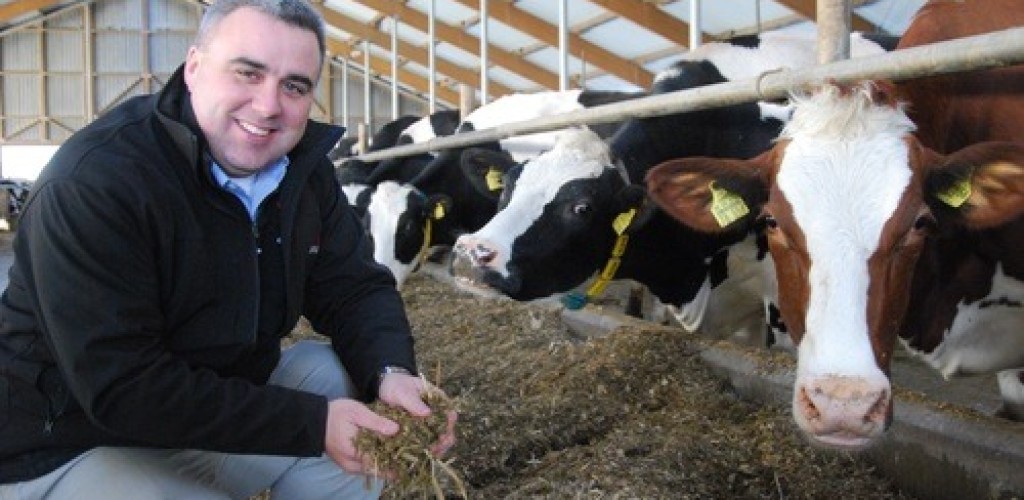
He’s been a top researcher into the metabolism, immune function, and nutritional physiology of cows, the go-to guy for farmers and others throughout the state dairy industry, and mentor to countless animal science students and Cornell Dairy Fellows. Now, professor Thomas R. Overton is taking on a new role: associate director of Cornell Cooperative Extension.
Overton will step into the shoes of Christopher Watkins, who became director of CCE in January, upon the departure of Helene Dillard.
“We are delighted to have Tom join the CCE team as associate director for agriculture and food systems,” Watkins said. “I have had the pleasure of interacting with Tom over many years, and have greatly appreciated his commitment to extension and the agricultural industry in New York. I feel fortunate to have a faculty member of his caliber helping to enhance the impact of Cornell University throughout the state”
As director of Cornell’s PRO-DAIRY program - a role he will continue to serve - Overton has worked extensively with statewide and regional extension teams to enhance the dairy industry in New York. He teaches numerous courses at both the undergraduate and graduate levels, and helps lead the Cornell Dairy Fellows program.
He was awarded the Cargill Animal Nutrition Young Scientist Award by the American Dairy Science Association in 2006 and the ADSA Foundation Scholar Award in 2007. In 2013, he was named a Faculty Fellow of the David R. Atkinson Center for a Sustainable Future.
Overton is a native of northern New York who grew up primarily in Massachusetts. He earned a B.S. at Cornell University and M.S. and Ph.D. degrees from the University of Illinois. He returned to Cornell in 1998 as an assistant professor and was promoted to full professor in 2013.


