Vine Balance and the Role of Vineyard Design
[Ed. Note: This article is adapted from both an eXtension article entitled Vine Balance and the Role of Vineyard Design, and a presentation entitled Rootstock Performance and Interactions with Vineyard Design, presented at the 2013 ASEV rootstock symposium, held in Monterey, California. Thanks to Jim Wolpert for permission to reprint and adapt this article for Appellation Cornell. – TEM.]
"Vine balance" can be defined as the condition in which 1) vine shoot growth provides enough leaf area to properly ripen the crop and 2) crop per hectare meets a grower's or vintner's goals.
Vine growth is the complex interaction of soil, climate, rootstock capacity, scion capacity, vine density, trellis system, shoot density, and cultural practices. The first six factors are chosen at planting and cannot be easily changed without significant inputs. The last two are ones over which the grower has input.
Optimum Shoot Density
Recent research has suggested that shoot density (shoot number/meter), controlled at pruning, is a critical component. The often recommended range in shoot density is about 12 to 15 shoots/meter of undivided canopy. If shoots are too dense, light in the fruiting zone is reduced, leading to reduced fruit quantity and/or quality. But if shoots are too sparse, fruit bearing surface (shoot number per hectare) is reduced, and therefore potential yield is lost.
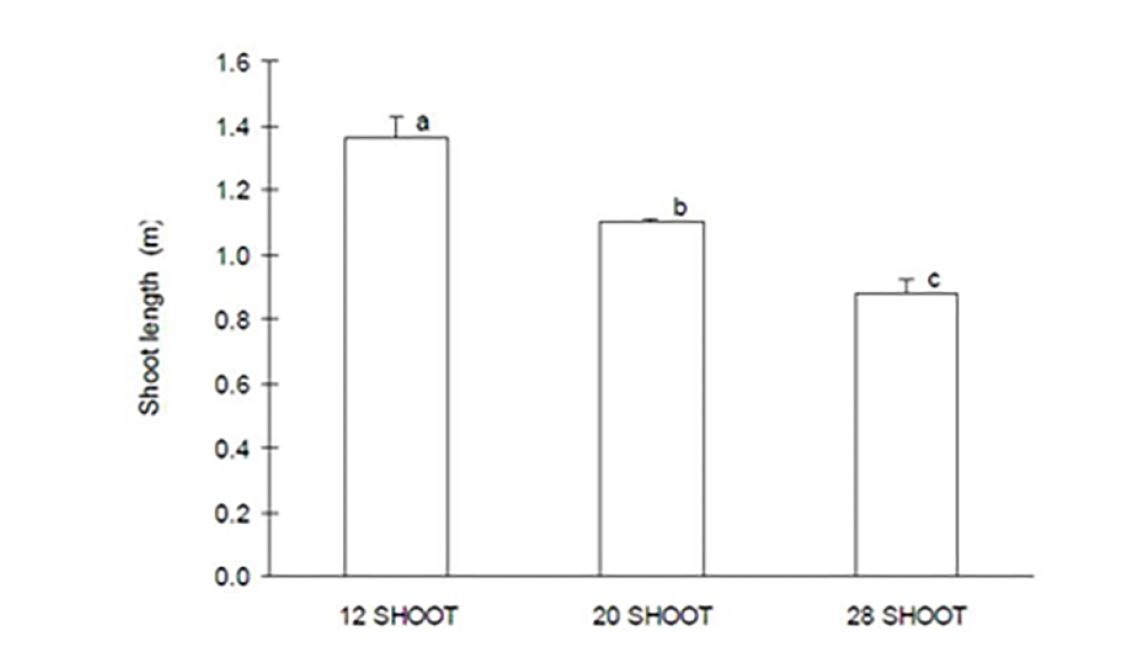
Another critical interaction is that shoot number per vine affects shoot length. If shoot number exceeds vine capacity, then shoots will be too short and will not have enough leaf area (12 cm2/g) to ripen the clusters on the shoot. However, if shoot number is too few for vine capacity then shoot length will be too long, with excessive leaf area per shoot and encouraging lateral leaf development in the fruiting zone.
Figure 2. In-row vine spacing provides the backdrop for regulating individual shoot growth. When vines are spaced too closely, the canopy will be excessively shaded or (if thinned) individual shoots will grow too fast. If the vine spacing is too wide, canopy fill will be uneven, and yield will be sacrificed. Optimum vine spacing will produce a balanced canopy without excessive growth or gaps.
Figure 2. In-row vine spacing provides the backdrop for regulating individual shoot growth. When vines are spaced too closely, the canopy will be excessively shaded or (if thinned) individual shoots will grow too fast. If the vine spacing is too wide, canopy fill will be uneven, and yield will be sacrificed. Optimum vine spacing will produce a balanced canopy without excessive growth or gaps.
Vine Spacing and Shoot Growth
Therefore, at a given shoot density (say, 12 to 15 shoots/m), shoot length depends on vine spacing, particularly in-row vine spacing. Or, to say it differently, to control shoot length in any given site/rootstock/scion combination, you must vary vine spacing. Increasing vine spacing increases shoot number per vine and shortens shoots, while decreasing vine spacing decreases shoots per vine and lengthens shoots. This is an unusual way to think about vine spacing but it illustrates the importance of planting time decision-making that growers must consider.
The difficulty, of course, is that a grower must have a priori knowledge of the successful integration of those complex factors to be assured of the proper amount of growth, meaning not too much or not too little. While growers in California have a great deal of experience making these decisions, it is safe to say that more information would be valuable.