Horticulture professor David Wolfe has spent the past 25 years studying the ecological impacts of a changing climate. But his investigations have also led him down a different path—one at the intersection of evolution and psychology.
At a Sept. 10 seminar hosted by the Department of Natural Resources, Wolfe questioned why humans have been so reckless when it comes to caring for their planet, and suggested the problem might stem from the evolution of the human mind itself.
“Our intelligence is constrained by the context of its evolution,” said Wolfe, who chairs the climate change focus group at Cornell’s Atkinson Center for a Sustainable Future.
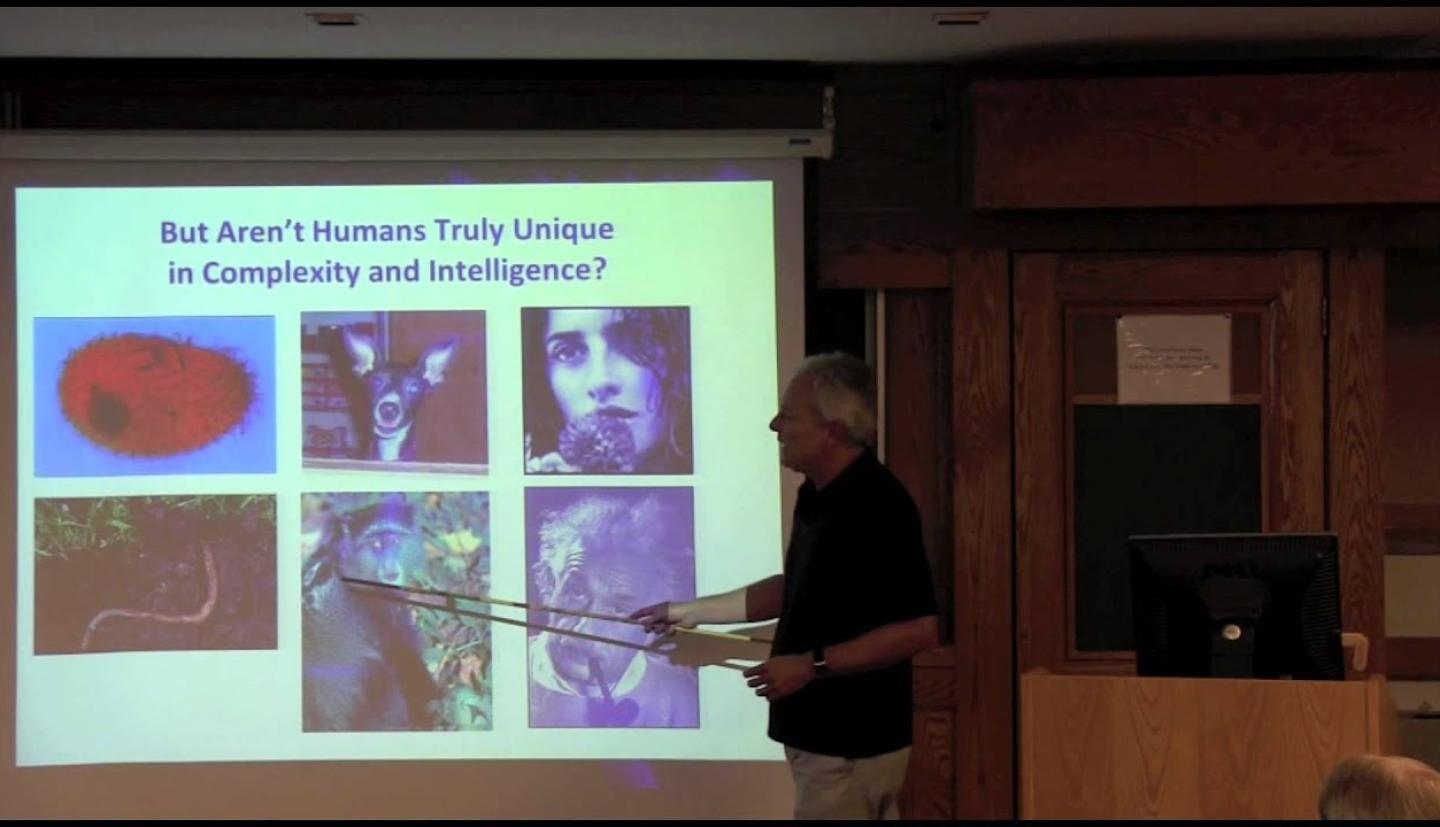
He introduced the concept of “species royalty,” the notion that human intelligence makes us superior to other species. Wolfe argued that intelligence is not a royal trait, and that it may not even be a very beneficial one in the long run.
“The trait [of intelligence] is a very recent introduction [to the tree of life], and whether it will be adaptive over the long haul has not been established,” he said. “In fact, it may be maladaptive, as it may lead to an illusion of separateness from other species, and an illusion of unbounded and unbiased mental capacity.”
But human mental capacity is far from unbounded, Wolfe argued, because of the constraints of evolution. As effective as evolution can be at producing organisms that are extremely well-suited to meet the challenges of their environment, it can be a pretty slow process—and in recent years, humans have rapidly created new environmental challenges.
“It took Homo sapiens about 120,000 years to produce one billion people on the planet, now it’s taking us only about a decade to add a billion people,” Wolfe said. “Our brains have not really evolved to keep up with that sort of population growth.”
Earlier in our evolution, when the human population numbered in the millions, there was no need to be concerned about stretching global resources too thin or causing large-scale environmental damage.
“The brain evolved in response to natural selection, which was not dealing with abstract global challenges, but local challenges,” he added. “The pace of climate change during the course of human evolution, even during the most recent ice age, was slower by many orders of magnitude compared to the pace of change projected for the coming century.”
This could explain the shocking lack of responsiveness to—and even flat-out denial of— climate change that has predominated, despite ominous warnings from the scientific community, he said.
Wolfe said he is still hopeful that humanity can and will adapt. Human population growth is finally beginning to decline, and this is a major step in the right direction, he said.
He stressed the importance of cultivating positive feelings for our Earth, rather than condemning it as a polluted mess.
“People don’t want to destroy what they love,” he said.
- Andrea Alfano ‘14