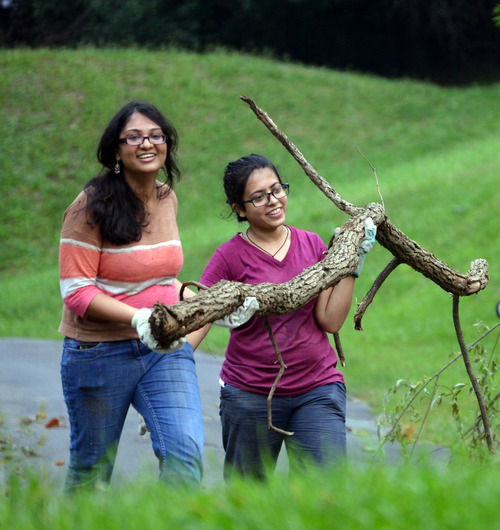
On Saturday, August 30, Dan Krall, associate professor of landscape architecture, led a volunteer clean-up of the historic Ithaca City Cemetery. The 220-year-old, 16-acre municipal cemetery is located just down the hill from West Campus and is adjacent to the historic Llenroc house, the former family home of Ezra Cornell and now the Delta Phi fraternity. With help from local historic preservation volunteers and student organizers like Swapna Kothari ‘14 (right), a graduate student in the School of Architecture, Art and Planning’s (AAP) Historic Preservation Planning Program, the event was organized as an orientation and welcome for new students in AAP’s Department of City and Regional Planning. Prof. Krall, who also chairs the Ithaca Parks Commission that oversees the cemetery for the city, identified invasive trees and bushes, especially those damaging headstones in the oldest part of the cemetery. In addition, he taught students how to sensitively remove tree limbs and trim back shrubs in order to restore the cemetery to its 19th century park-like appearance. The event was well attended by AAP and CALS students, as well as by local residents and alumni, who worked throughout the day collecting trash, trimming trees, and identifying monuments in need of conservation.
For those interested in finding out more about this kind of historic landscape preservation, an upcoming one and a half-day interactive workshop will be taught in the cemetery. Sponsored by Historic Ithaca, Inc. and the Friends of the Ithaca City Cemetery, and supported by the Cornell University Departments of City & Regional Planning and Landscape Architecture, as well as the City of Ithaca, the Historic Stone and Tombstone Conservation Class will enable participants to get a taste of what began in the 1790s as a burial ground, and later became a "rural cemetery" - a place of pastoral beauty, contemplation, and public gathering - filled with unique plantings, sculpture, and landscaped vistas. The emphasis of the workshop will be on introducing participants to stone conservation procedures and techniques, and applying these treatments to headstones and monuments in the cemetery that have been selected for conservation. Participants will also have the opportunity to re-set a tablet stone, join broken gravestone fragments, consolidate weak or decaying gravestones using infill, safely clean gravestones, and more.
The workshop will run from 8:00 a.m. to 5:00 p.m. on Friday, September 20, and 9:00 a.m. to 1:00 p.m. on Saturday, September 21. There is no charge for Cornell students, and 1 credit may be available. To apply, contact Michael Tomlan (mat4 [at] cornell.edu), professor of city and regional planning, or Professor Krall (dwk [at] cornell.edu).
The general public is also welcome to participate. The price is $200 per person for both days and includes all materials, handouts, and lunch on Friday. A reduced price of $40 ($35 for Friends of Historic Ithaca and Friends of the Ithaca City Cemetery) is available for participants interested in attending the Saturday session only. Register Online or call Kristen Olson (607) 273-6633.
Registration closes at midnight on Monday, September 16.