

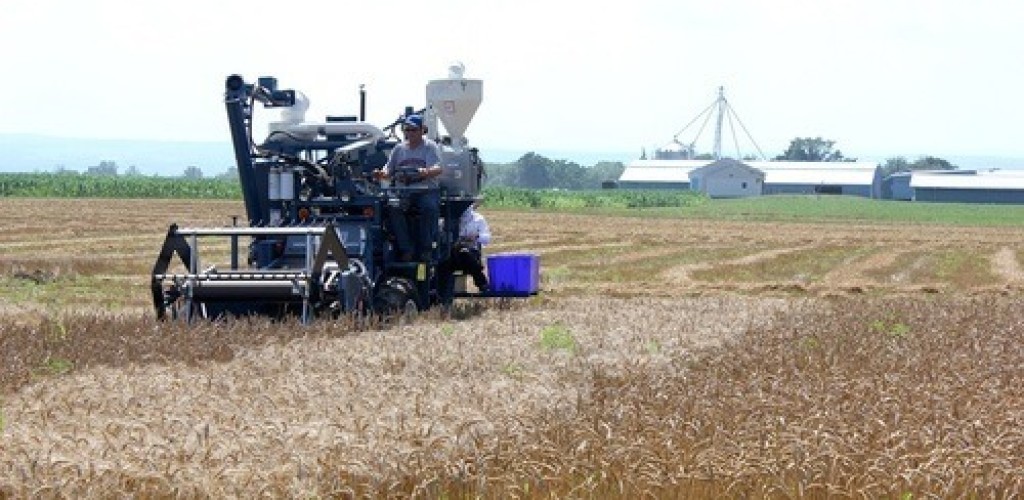
It may weigh more than three tons, but the new research combine in use on the farms of the Cornell University Agricultural Experiment Station (CUAES) is a model of precision and flexibility. Tailor-made for research, the combine will help Cornell researchers extract crucial information from grain trials—from evaluating the performance of new varieties to assessing methods for disease control.
“If you visualize a typical crop field, one variety is grown across many acres. But our research grain trials are often comprised of many individual plots measuring only five to six feet wide and 20 to 30 feet long,” said Glenn Evans ‘03, M.S. '07, Ph.D. '10, director of agricultural operations for the farms and plant growth facilities of CUAES. “Research trials are a patchwork, and we needed a specialized plot combine to collect data and seed samples from each swatch, accurately and efficiently.”
The new combine, a $260,000 Almaco SPC-20, will do just that. It collects data on seed moisture and weight as each plot of grain is harvested, storing the data on an onboard computer…


