If a new research effort beginning at Cornell’s Willsboro Research Farm is successful, the juneberry, a Canadian cousin of the eastern serviceberry, may soon find a new home among the commercial berry patches of New York State. One of the largest juneberry nurseries in the country is being established at the Northern N.Y. research facility with funding provided by the Northern New York Agricultural Development Program.
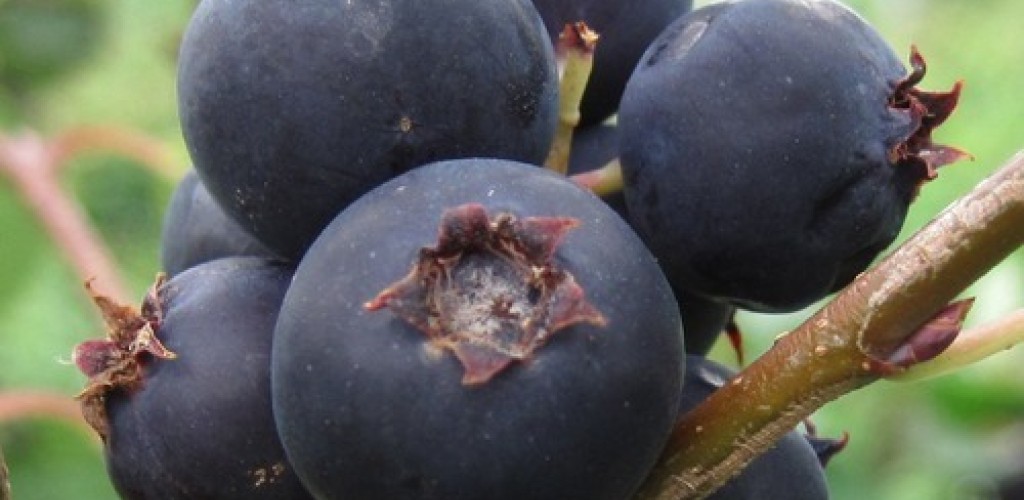
Though it resembles the blueberry, the juneberry is more closely related to cherries and plums, with a flavor reminiscent of dark cherry or raisin. In addition to being delicious, these “super fruits” are also nutrient-rich, with high levels of protein, calcium, manganese, iron, fiber, and antioxidants.
“Juneberry is grown in the western U.S. and Canada as Saskatoon berry,” said Willsboro Research Farm Manager Michael Davis. “In the Eastern U.S. and Canada, it grows in the coastal states stretching from Virginia north to Maine and Nova Scotia.” Although the plant prefers sandy coastal regions, it also thrives in other habitats, such as woodland clearings, pond margins, and other dry, open areas.
Although recent efforts at Cornell have focused on introducing the juneberry to New York’s small-scale growers, this new project is being undertaken in conjunction with a larger effort aimed at evaluating the viability of widespread production of the berries throughout the Northeast. “The multi-state project team is collecting wild cuttings and seeds in multiple states and Canada for a genomic database and the development of lines suitable for production in the Northeast,” said Davis. “As a June-July harvest crop, Juneberry would produce revenues early in the growing season for producers. [It] could prove to be a super fruit not only nutritionally, but economically for Northern N.Y. growers.”
The first commercial-scale crop is expected at the Willsboro nursery in 2015.