

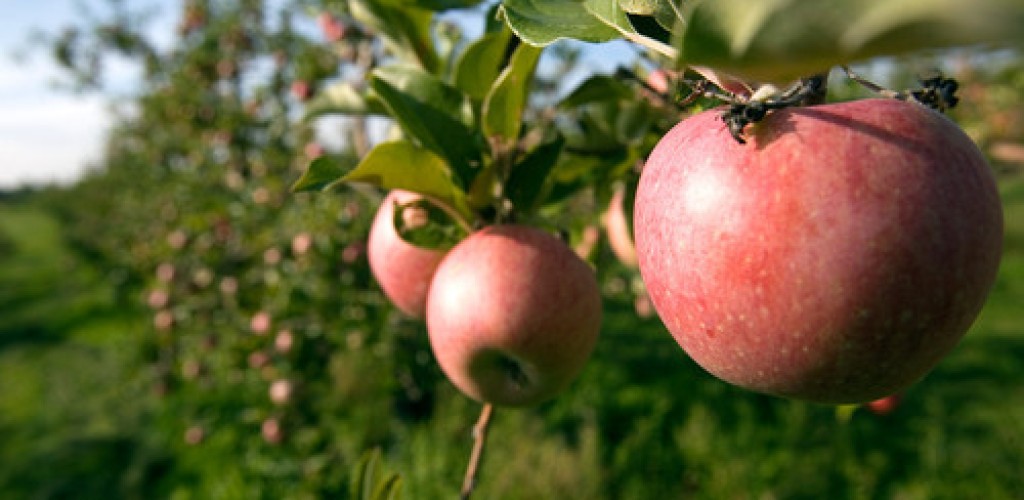
Apple growers across New York are breathing a sigh of relief this spring after 2012’s unseasonably early thaw and harsh spring frosts devastated apples trees throughout the state and caused a 40% drop in production for the year. But although the weather may be better in 2013, another threat looms large in the nightmares of growers: fire blight.
Fire blight is a bacterial disease in apple trees that earns its name from the scorched appearance of infected leaves and branches. The disease spreads quickly and if left unchecked, can wipe out entire orchards in a single growing season. Even relatively routine weather events, such as the recent hail storms experienced in the Finger Lakes region, can make apple trees more susceptible to infection. As Susan Brown, professor and associate chair of the Department of Horticulture points out, “…hail makes wounds in the leaves, fruit, and shoots that are an entry point for the fire blight bacteria. That coupled with high temperatures, humidity, and moisture (rain/dew) create the ‘perfect storm’ for infection.”
For years, fire blight was kept at bay using antibiotics, but in late 2011 streptomycin-resistant strains were found in several locations in the state. Since then, researchers from the New York State Agricultural Experiment Station (NYSAES) have worked to develop new orchard management guidelines to help growers control outbreaks among existing trees and prevent them in new plantings.
Yet, despite these efforts, the threat from fire blight remains high, especially for growers who produce some of the most popular varieties with consumers. As Herb Aldwinkle, professor emeritus of plant pathology and plant microbe biology at NYSAES recently explained, “…unfortunately, those tasty new apples like Honey Crisp and Gala that people seem to be buying more of, they’re sensitive to the disease and we don’t have any resistant varieties that are of such good quality.”
Aldwinckle’s lab is currently working to modify apple genes to breed higher resistance in popular varieties. But until they are successful, diligent orchard management remains the only effective defense in this ongoing battle between man and bacterium. Think about that the next time you bite into a juicy red beauty!


