


Explore the history of the Cornell University Herbarium
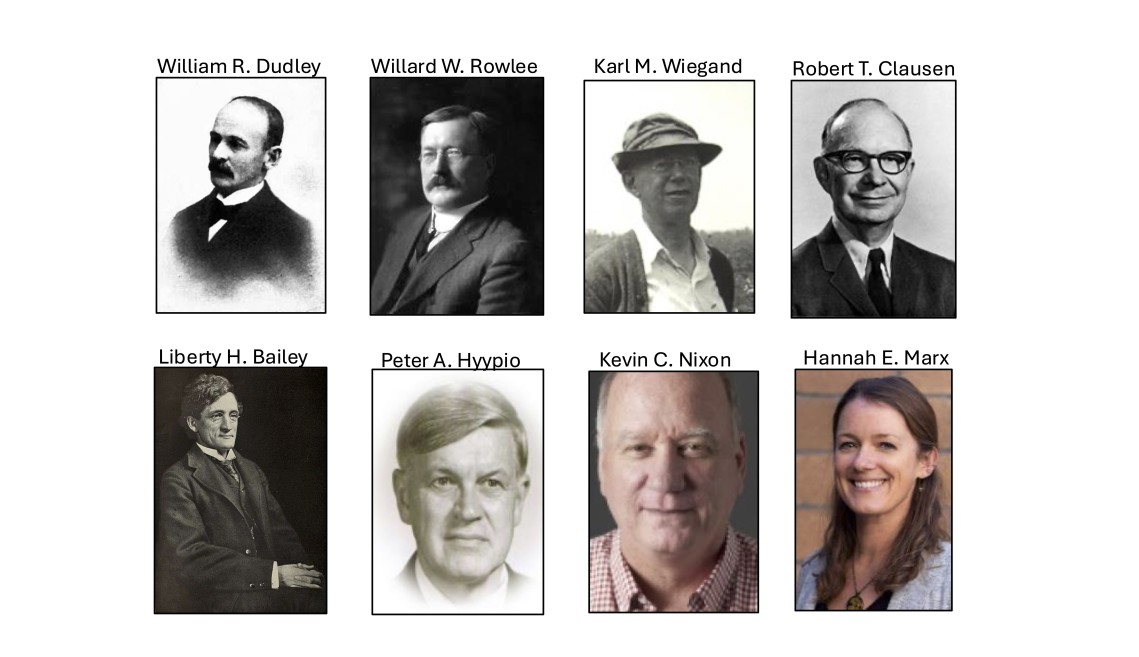
Cornell Herbarium Curators through the years
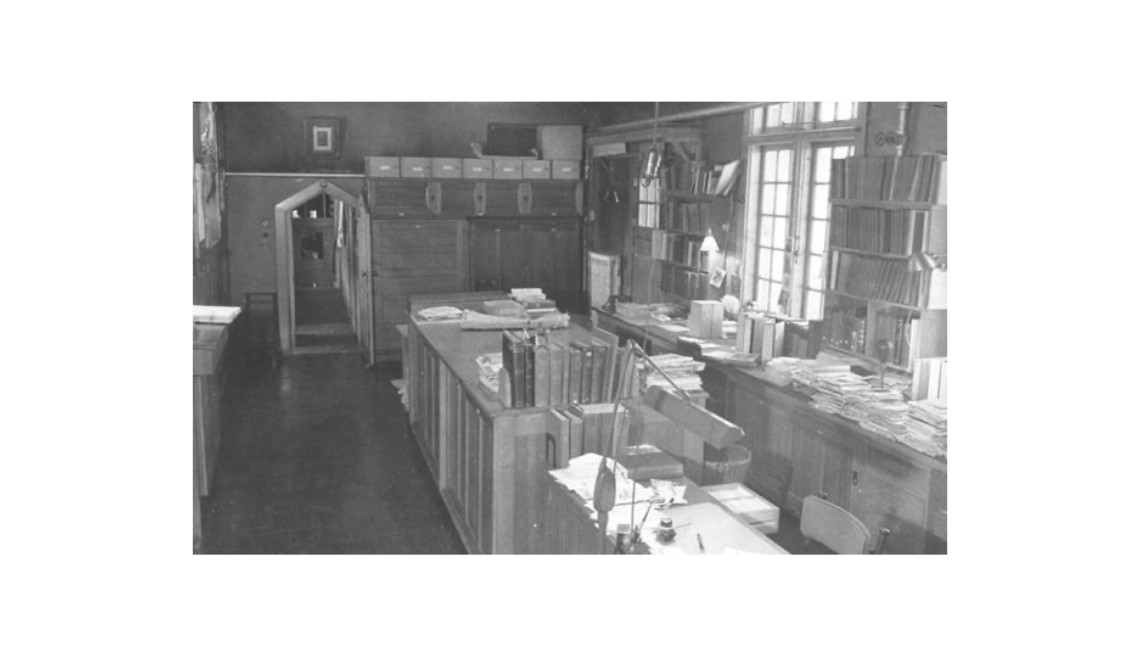
Herbarium Facilities during Liberty Hyde Baileys tenure
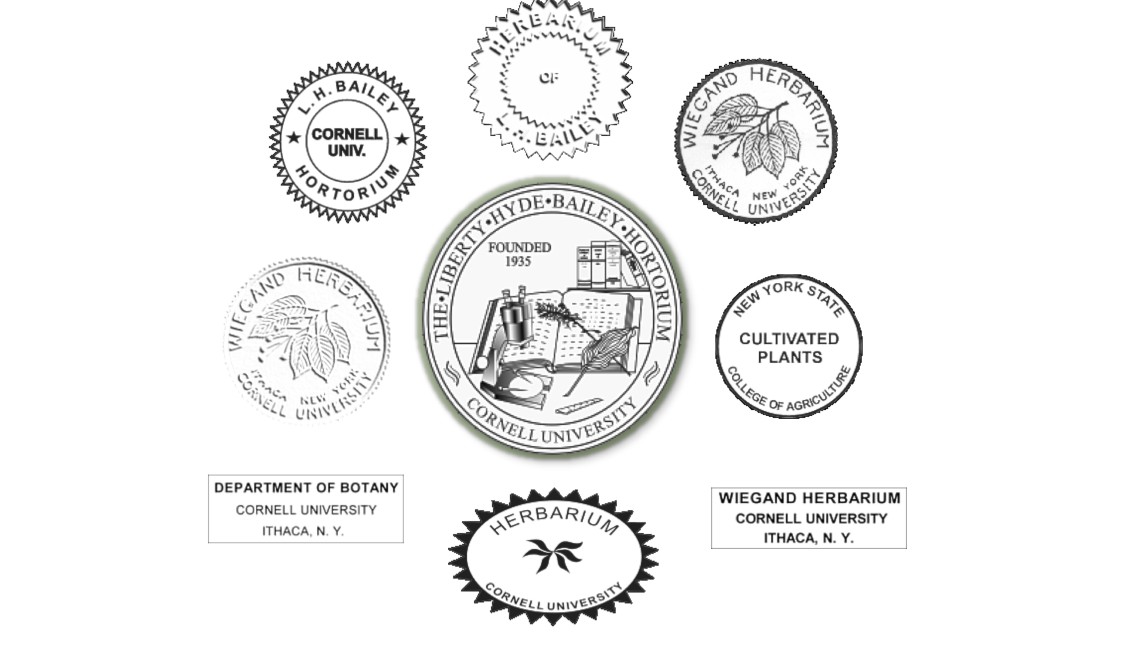
Herbarium accession stamps over the years
Early beginnings
In 1869, Andrew D. White, Cornell’s first President, purchased the private herbarium of Horace Mann, Jr.. Mann’s 12,500 specimens became the nucleus of the herbarium of the new Department of Botany in the College of Arts. The first curator of the collection was William R. Dudley, who added many of his own specimens in addition to acquiring many sets of notable specimens. Following Dudley, Willard W. Rowlee, instructor and professor of botany from 1889-1923, next served as curator, expanding the collection further.
Turn of the Century
In 1913, Karl M. Wiegand started a formal herbarium in the new Department of Botany at the College of Agriculture, expanding off the former collection work before the turn of the century. Over the course of Wiegand’s career at Cornell, the collection grew to over 225,000 specimens. Both herbaria of the College of Agriculture and of the College of Arts were brought together in the new Plant Science Building in 1931. Dr. Wiegand continued as curator of the consolidated collection, now known by the abbreviation CU, until he was succeeded by Robert T. Clausen in 1941. The herbarium was officially named in honor of Dr. Wiegand in 1951.
The Bailey Era
The Bailey Hortorium was conceived and founded by Liberty Hyde Bailey, and had its beginning in 1935 when he gave to Cornell the land, buildings, herbarium collections, a massive horticultural catalogue collection and a horticultural-botanical library that he had been building since the 1880s. Bailey defined the Hortorium as ‘a place for scientific study of plants of the garden, for their documentation, their classification and for their naming.’ The Hortorium collection was curated by Ethel Zoe Bailey (daughter of L.H. Bailey) from 1935 until her retirement in 1957.
Integration of the Collections
Brought to the newly constructed Mann Library building in 1953, the two collections, CU and BH, were housed side by side but not merged until 1977, under the supervision of then-curator Peter A. Hyypio. Subsequently known as the L.H. Bailey Hortorium Herbarium and abbreviated BH, the collection now contains about 950,000 specimens of cultivated and wild plants.
The Modern Era
Since 1985, Kevin C. Nixon has served as faculty curator of the BH herbarium. In 1996, the College of Agriculture and Life Sciences began a decade-long renovation of Mann Library building, the second phase of which necessitated the move of the BH collections to an off-campus location in 2003. The move of the collection back to the newly renovated space in Mann began in February 2008, at which time family circumscriptions were implemented following a modified APG II classification. The state-of-the-art facility now includes 926 new herbarium cases, a large work room and a walk-in freezer, imaging rooms and naturally lit workspaces. The relocated Hortorium Library sits adjacent to the herbarium, readily accessible to all patrons.
Present Day
The L.H. Bailey Hortorium is an historical unit currently administered within the Section of Plant Biology within the School of Integrative Plant Sciences (SIPS) in the College of Agricultural Sciences (CALS) at Cornell University. Beginning in January, 2025, Hannah E. Marx replaced Kevin Nixon as Director and they are now ushering in the new era of the herbarium. The BH herbarium now includes ca. 950,000 dried plant specimens, which makes it among the largest university herbaria in the US. The herbarium is active with students, volunteers, and researchers. If you are interested or want to get involved, email us at herbarium [at] cornell.edu.
Help us secure our future
If you are interested in donating, please reach out to our Director, Dr. Hannah Marx, at hem73 [at] cornell.edu.