


This project asserts the role of maintenance to re-shape relationships within Mud Island Park in Memphis, TN.
While the site is immediately adjacent to the dynamic Mississippi River and as urban heat becomes increasingly dangerous, frequent mowing suppresses floodplain ecologies and large shade trees are imperiled by dominant neighborhood groups. The site appears inaccessible, serving a fraction of potential users despite public ownership.
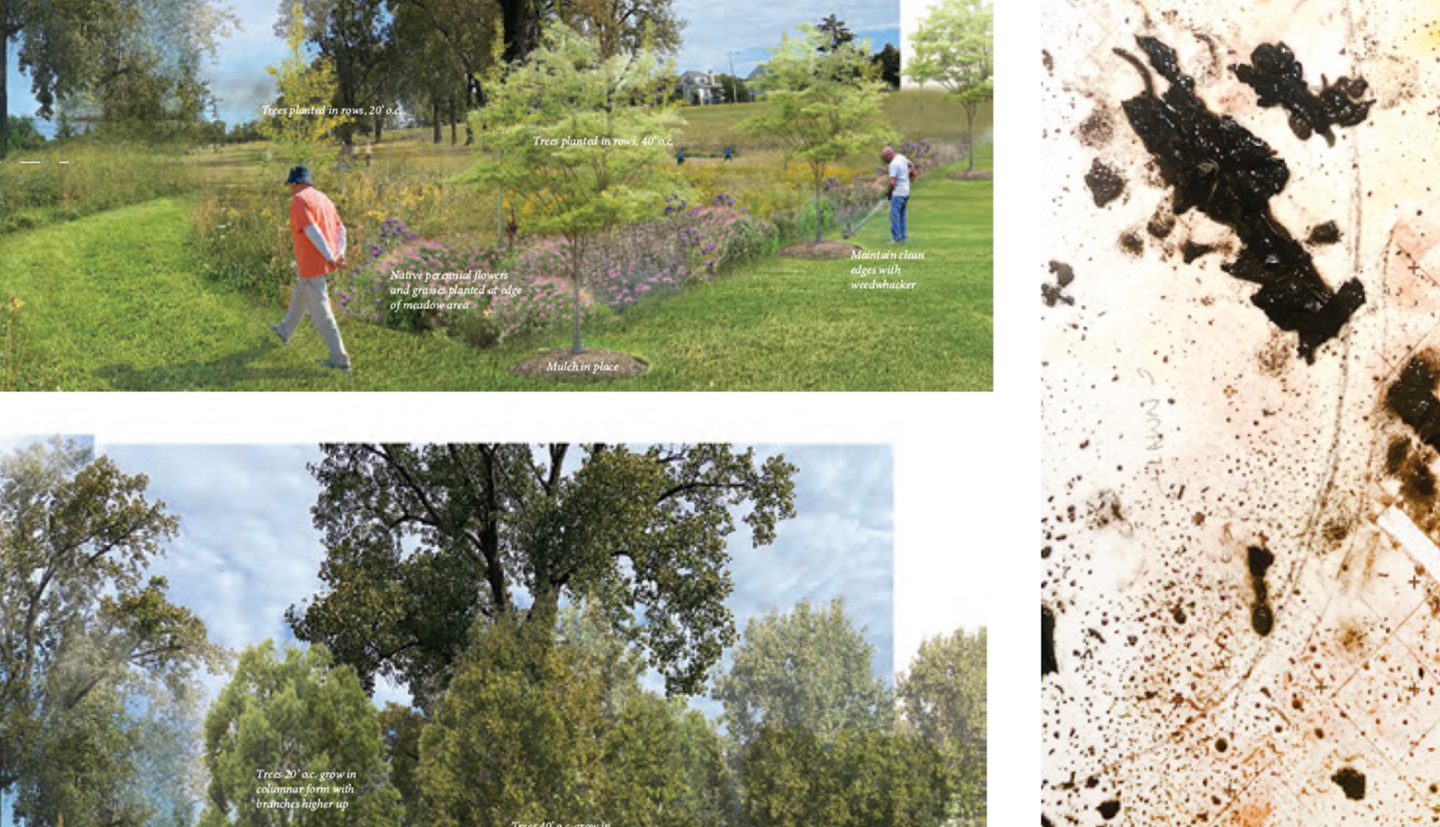
The proposal conceptualizes a series of decisions which incrementally shift relationships. Processes of contestation and disruption can lead to important community-wide conversations by revealing diverse values and hopes for the site. Guiding ecological succession shapes spatial compositions of plant communities. Strategies include a variety of mowing, pruning, thinning, protection, and planting methods to diversify the densities, textures, and heights of woody and herbaceous plants. This transforms the site into a patchwork of ecological and programmatic assemblages that frame river views, bloom ephemerally, create microclimatic shade, and provide a network of spaces for gathering, circulation, and recreation.
Process-based diagrams, drawings, and physical models capture the experimental, fluid nature of the site, illustrating trajectory scenarios of the open-ended nature of the proposal and engaging with the physicality of water and sediment.
Maintenance invites community caretaking and continual re-evaluation of values demonstrated through public space. Emergent expressions of Mud Island Park can build resilience amid community divisions, loss of native habitat, and erasure of floodplain identity. Community and ecological relationships are powerful agents of design over time, enacted through practical gestures of maintenance and yielding multiple potential futures.
Kate Chesebrough MLA '24
Course:
LA 6010 Integrating Theory and Practice I
Jamie Vanucchi, Instructor
Semester:
Fall 2022
This project was submitted alongside a few other projects from the department to the Barcelona International Landscape Biennial. Cornell was selected as one of the finalists for the 13 International Landscape Architecture Prize Ribas Piera 2025.