


Drawing on fieldwork conducted in designed forests and urban treescapes in Europe, this thesis translates the legacy of planted forest parks into design tests based in Ithaca, New York.
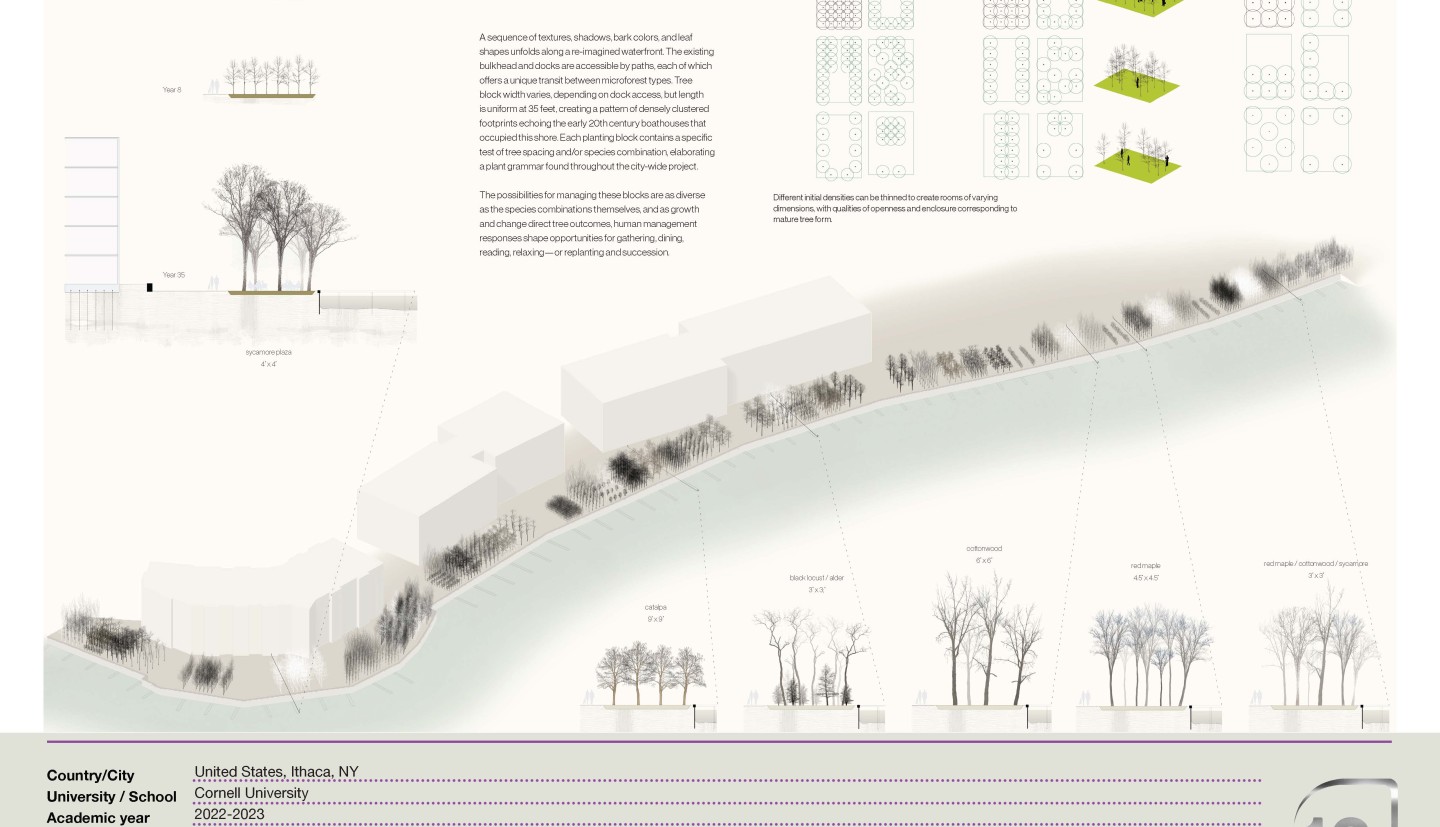
Ithaca is a city of channelized creeks and infilled wetlands where increasingly intense rainfall events reveal the present-day inadequacy of historical planning decisions. Twentieth-century water control infrastructure was built at the expense of an existing tree vernacular where quick-growing species adapted to wet or challenging soil conditions found pride of place along pedestrian-friendly watersides. Landscape Arborism reclaims Ithaca’s tree identity and mobilizes it to create climate conscious and experientially diverse public space.
Pairing one key design move—planting densely, in a grid—with principles of creative management allows for experimentation and discovery while guiding trees toward desired future forms. Trees are more than instruments we task with absorbing carbon and providing shade; their capacity to structure space and foster sense of place combines occupiable infrastructure with civic good. Assembling a new urban tree lexicon establishes the conditions for an endless series of relations and negotiated actions between people and trees in close proximity to each other. Ultimately, this approach suggests a new development paradigm wherein trees drive landscape change alongside planners and designers.
By offering a range of planting strategies rooted in site history and foregrounding the role of human management through time, Landscape Arborism articulates a new power for trees as spatial coagents of the continually unfinished future city.
Dan Meyer, MLA '23
Course:
LA 8900 Master's Thesis in Landscape Architecture
Maria Goula and Jamie Vanucchi, Faculty Advisors
Semester:
Spring 2023
This project was submitted alongside other projects in the department to the Barcelona International Landscape Biennial. It was selected as a finalist for the Ribas Piera Prize 2025.