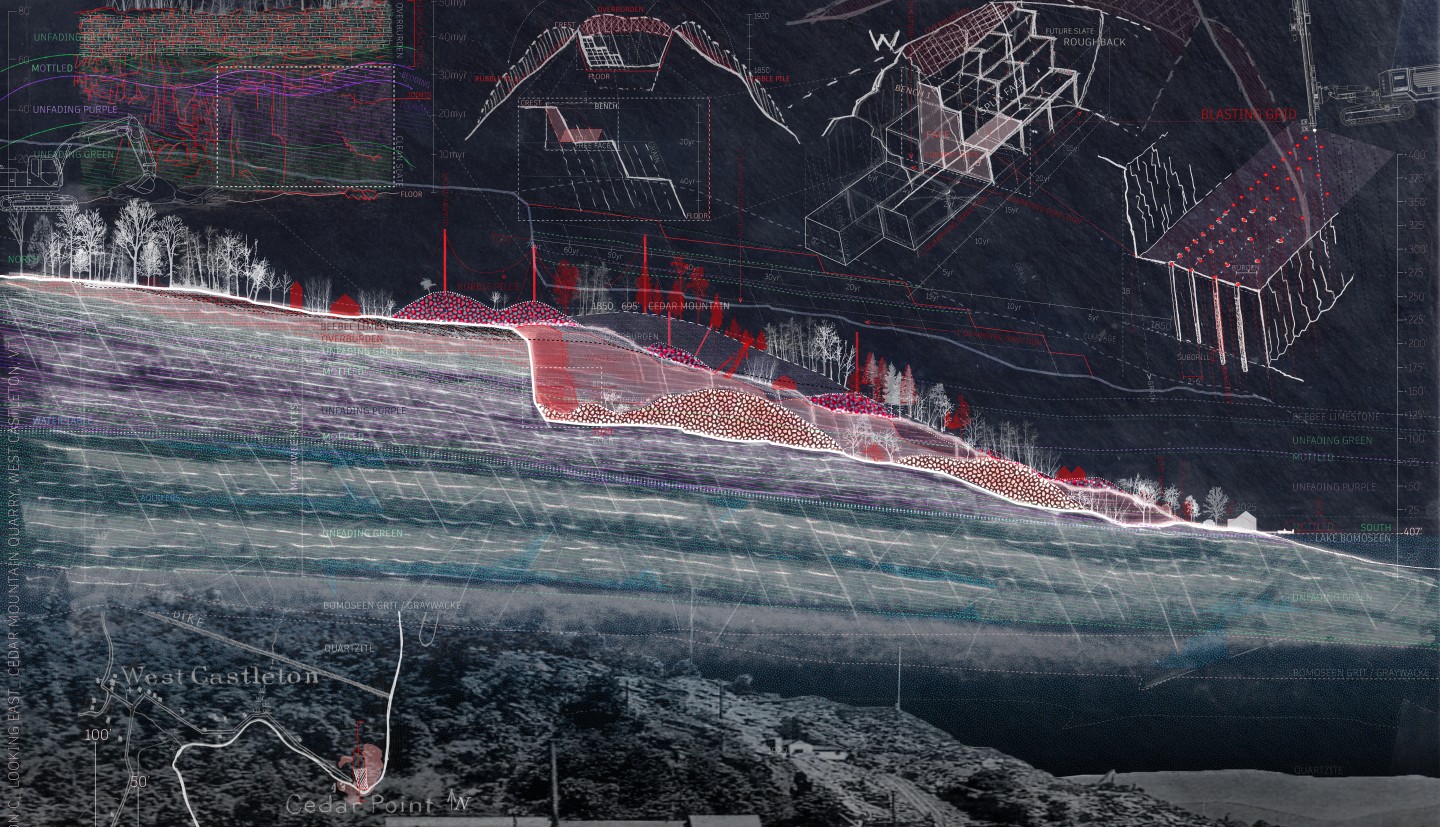
The post-extracted landscape of the slate quarries along the border of southwestern Vermont and eastern New York provides an opportunity to investigate how the extremely different, yet overlapped scales of ecological succession and geological time can be utilized to create sense of place for a community facing rapid economic and cultural shifts away from a historic way of life based on quarrying.
Rather than seeing these scarred landscapes as disrupted ecologies needing to be fixed (reclaimed, repaired, or restored), they should be seen as important remnants of a waning place-based identity.
The former Cedar Mountain Quarry becomes the site of design investigation. As a result of the quarrying process, not only has the physical matter of the land been altered, but the landscape of the rubble piles is in a state of perpetual disturbance and suspended ecological succession. It is almost as if geological time, which functions in scales of hundreds of millions of years, has been imposed into the timescale of ecological succession which is typically hundreds of years. Controlled succession (with Materiality) becomes the design medium. This condition of simultaneous timescales (thick time) is embodied in the physical matter of the accumulated waste piles, and unique materiality of the slate, as is the cultural time-frame and legacy of 200 years of this economy and trade that defined the local community.
The uncertain shape and dynamic topography of this post-extracted landscape is a result of efficiencies and specifics of the quarrying processes, tools, and skills that are tailored to the irregular, fractured landscape of the local slate geology. These same skills and tools that essentially defined the current form of the landscape, and also the culture and identity of the area can not only be elevated, but also be employed in the design language and tools of creation of the new landscape that can become the landscape from which to base a new Sense of Place.