


Located in the Black Dirt Region of the upper-middle reaches of the Wallkill River Basin, this project addresses a landscape shaped by glacial activity and long-standing wetland processes.
The region’s rich organic soils, the remnants of ancient swamps, once supported diverse native habitats, but decades of agricultural intensification have led to fragmentation and ecological decline. After extensive research, study, and design, the proposal puts forward three interwoven strategies to balance ecological regeneration with local economic benefit. Promote wildflower turf production to reintroduce perennial root systems that act as carbon sinks, while providing a resilient and diversified agricultural product that mitigates supply-demand imbalances. Create pastoral complex in regularly flooded zones to avoid excessive carbon release from soil disturbance, while offering new grazing-based land uses that function as flood buffers. Reactivate green spine by gently reshaping the straightened river channel using low-cost interventions, restoring the site’s flood-storage capacity, accessibility, and aesthetic value. Together, these strategies aim to deliver a low-carbon, ecologically vibrant, and economically viable future for the Wallkill landscape. Together, these strategies foster a low-carbon, ecologically vibrant, and economically viable future for the Wallkill landscape. By linking production with restoration, the project enables customers to actively support biodiversity and carbon capture, while offering a scalable model for regenerative land use across the region.
Huanran Li, MLA '23; Andrew Ziyuan Zhang, Visiting Student
Course:
LA 7010 Urban Design and Planning
Anne Weber, Faculty Advisor
Semester:
Fall 2023
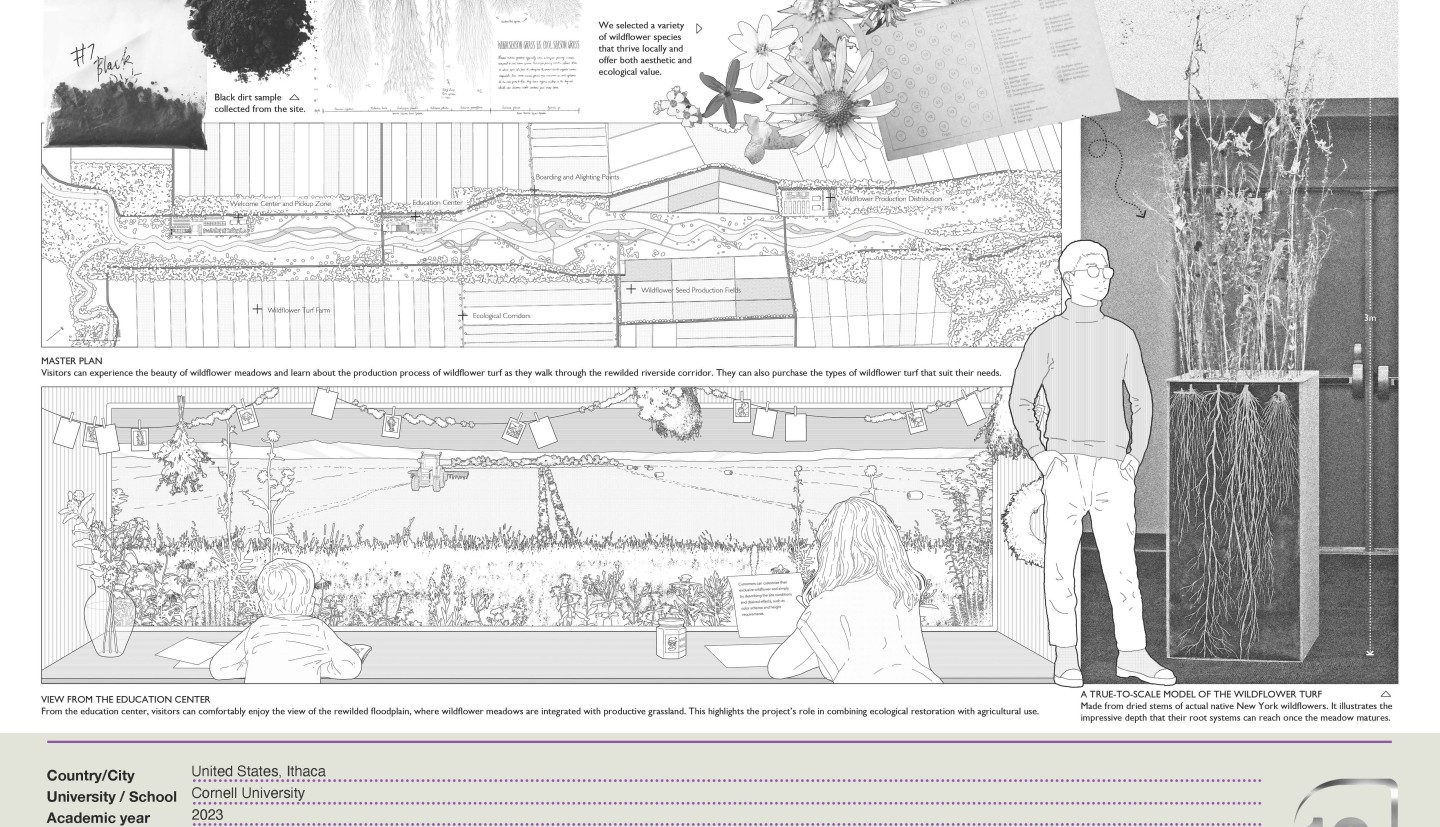
This project was submitted alongside other projects in the department to the Barcelona International Landscape Biennial. It was selected as a finalist for the Ribas Piera Prize 2025.